Year-End Musings (12/19/2025)
Riddleblog and Blessed Hope Updates:
The schedule for Riddleblog posts and Blessed Hope podcasts will be a bit irregular between now and year’s end. I am taking some time off to enjoy the grand kids
Lord willing, in the new year look for an upcoming Riddleblog exposition of the Book of James, as well as a Blessed Hope Podcast season five series on the Book of Romans coming in the Spring of 2026 (upon completion of 2 Corinthians)
Thinking Out Loud:
The best thing about a made-up holiday like Festivus, is that it has pushed another made-up and much more farcical holiday (Kwanzaa) off the public radar
For a host of reasons, I am all in favor of a social media block for kids under sixteen (as Australia has done and the UK is considering). I am also sorta in favor of a social media block for everyone over sixteen
In light of the Reiner tragedy, why do so many podcasters, celebrities, and politicians (many of whom did not know the family personally or anything about their circumstances) feel compelled to pontificate about the Reiner family’s trials and troubles? These folks are playing the role of Job’s counselors—they are nothing but gawkers and click seekers hoping to explain or take advantage of someone else’s tragedy. The only true comfort Job received from his three friends (Eliphaz, Bildad, and Zophar—Job 2:11-13) was when they sat with him as he mourned and kept their yaps shut. There’s a lesson there
There’s a new Democrat candidate running for governor of California—gazillionaire environmentalist, Tom Steyer. Trying to sound like a tough guy, his initial campaign ad begins with Steyer taking the Lord’s name in vain. Not a peep so far from Christians who should be thoroughly offended by such a willful violation of the 3rd commandment
I have a confession to make—I watch Curse of Oak Island on the History Channel. Whew, glad to get that off my chest. The archaeological stuff and the scientific metallurgy for dating old objects and determining their composition is fascinating to me. Nor was Columbus the first European to arrive in the Americas—the Norse beat him by 500 years. But the Templar stuff and the “curse” nonsense is laughable. No wonder there is a “could it be?” drinking game
Two of my grandsons are now old enough for plastic army men as a Christmas gift! My yard is full of petrified decaying plastic relics of the grenade thrower, the mine sweeper, and the machine gunner from my youth and that of both of my sons. Now my sons and grandson’s yard will be a home to lost army men well. Next year will probably be the first electric train
Recently Read:
We all know nice Muslim people who are good citizens and wonderful neighbors. Many of these folks Americanize much like the countless immigrants who preceded them. They make valuable contributions to our communities.
But it is impossible to escape the fact that various Islamic groups, Imams, and individual fanatics are committed to the spread of Islam by any means—including acts of violence, intimidation, and the adoption of Sharia instead of American constitutional liberties. Social media has exposed a surprising level of vitriol, disgust at the American way of life, open hostility to the West, with angry threats especially towards Christianity and Judaism.
While such hostility and violence may be new to a-historical Americans, Islam has a 1,400 year history of bloody and violent conflict with the West and Christendom. Americans may know the Crusades were bad (and they were in large measure) but have no knowledge that the Crusades were conducted in light of the threat of an Islamic invasion of Europe, which would be the inevitable consequence of the fall of Constantinople. Islamic designs on the capital of the Holy Roman empire date to early in the 8th century CE, and were finally achieved in 1453 CE. It was not long after, that an army of the Ottoman empire was moving on Vienna before being turned away—an event which prompted a fair bit of worry on Martin Luther’s part.
On the other side of the European continent, the Battle of Tours was fought in 732 CE in Gaul (now France) when an Islamic army moving north from Spain was defeated by Charles Martel—a hugely important but largely forgotten moment in European history. If we have little or no idea of the history, brutality, and extent of the conflict between Islam and the West, we will miss the fact that what we are witnessing from militant Islamists may be new to us, but it has many and quite violent antecedents.
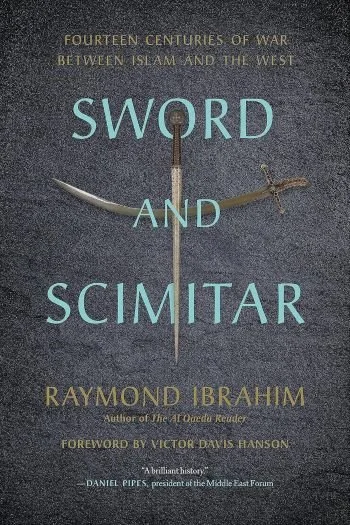
Raymond Ibrahim’s Sword and Scimitar is a well-documented, military history of the wars between Islam and the West during the fourteen centuries since the rise of Islam. Ibrahim is a former student of Victor Davis Hanson—who endorsed the volume. Ibrahim’s book reads well, which is an important achievement since the volume of 300+ pages surveys the lengthy history of this conflict. Ibrahim takes the reader from the times of Muhammad, to the rise of Jihad [warfare to spread Islam], to Islam’s rapid spread through what were then Christian lands in Syria, Egypt, North Africa, and Spain. The spread of Islam into regions north of the Arabian peninsula led to an inevitable conflict with Christian “infidels” at Yarmuk in Syria in 636 CE. Ibrahim’s narrative comes to a close with the eventual rise of modern European military power quashing Islamic efforts at further conquest (which Islamists speak of as “openings”) culminating with the fall of the Ottoman empire in the 1920s—efforts which have resurfaced in our own day and age.
Given its graphic and brutal content this is not an easy book to read (nor review). The non-Western names of participants and the details of the numerous conflicts mentioned, require the reader’s full attention to keep track. One example must suffice—the battle at Yarmuk. Drawing upon Islamic and contemporary sources, Ibrahim documents how the first Islamic army captured a group of Roman reinforcements making their way to the Syrian position, beheaded nearly 4,000 of them, and then placed the severed heads on pikes. When the Roman army refused to surrender at the sight of such brutality, the Islamic army of Allah beheaded another 1,000 men in front of the watching army. This led to a fierce six-day back and forth battle, eventually won by the Islamicists over a technological superior Western army. An unexpected sandstorm gave the Arab-Muslims the edge with the Syrian-Romans eventually wiped out to the last man.
From that time on (as documented in The Sword and the Simitar), Islamic armies saw themselves as possessing Allah’s favor and that defeating infidels in the most brutal manner possible would bring him pleasure and glory. When ISIS engaged in similar behavior in the recent past, we in the West were horrified. But we were witnessing an emerging Islamic army trying to build an Islamic caliphate using the same methods of intimidation as Islamic armies of the past—armies which ISIS saw as heroic models to follow. We witness similar brutality in Sudan and Nigeria.
The fusion of Islamic military goals (conquest) and Islamic views of how “infidels” should be treated were formed in the earliest days of emerging Islamic conquests. Infidels have a choice. They can: 1). Convert to Islam and be spared, or 2). Pay the Jizra [a tax or tribute] and live under Islamic rule, or 3). Be killed, their wives and children enslaved, or worse.
Ibriham raises an important theological point that we should not overlook due to our horror at Islamic brutality. From the beginning of the spread of Islam (with its destruction of churches, Christian villages and settlements, and the enslavement of survivors) Christians identified Muhammad’s two great sins giving Islam its anti-Christic nature. The first is that Islam is a religion grounded in male sexual pleasure (in this life, anticipating Paradise in the next)—the Islamic treatment of women grows out of Arab tribalism and is imposed upon both wives and those conquered. The second is the slaughter of non-Muslims as the means to ensure that the Islamic goal of conquest is achieved—with the infidels intimidated and their shed blood bringing glory to Allah. No doubt, Christians have committed shameful atrocities in this ongoing war as well. But Christians regard these atrocities as sinful acts, not prescribed conduct which pleases God.
I am very thankful that the vast majority of Muslims are indeed peaceful and good neighbors. But I cannot help but wonder if they are as ill-informed about the history of the conflict between Islam and West, as are so many Christians. Muslims can live in peace only by ignoring or rejecting Islam’s stress upon conquest through Jihad. Raymond Ibrahim’s Sword and Scimitar recounts this brutal history from Islamic sources in a readable and fast-moving summary. As unpleasant as it is, this is history we all should know more about if we want to understand our own troubled times and the terrible things we see far to often in the news.
Recommended Links:
A Mike Horton classic: When Heaven Came Down
Britain is taking a very dark turn. Churches are empty, Mosques replace them, and the woods are full of people doing weird things while wearing weird outfits. Paganism is on the rise, and where the “nones” in the UK are ending up
A very helpful discussion by Aaron MacLean identifying the four foreign policy categories which currently drive American foreign policy. He brings clarity. Very helpful
Wes Huff on P66— just how much of a 2nd century copy of John’s gospel do we have?
Over at Reformed Reader, Shane Lems pulls out some remarkable Herman Ridderbos quotes from his book The Coming of the Kingdom “on this world conquest,” which is a prominent feature of both Christian nationalism and postmillennialism. Lets just say Ridderbos raises some significant challenges
Fun Links:
What do you enter regarding place of birth on the birth certificate?
Not for the faint of heart! Is that lump on your forehead moving?
This certainly beats prison gruel and baloney sandwiches
I didn’t care very much for the series either
The thief learns an important lesson: This too shall pass
A record to be truly proud of! Nothing can match it
A human right, Maybe. But why exercise it?
Not on your life am I going in there. A spider’s entry into the Guinness Book
Prophecy Pundits take note—you’ve got competition
Previous Musings:
November Musings (November 5, 2025)
Video: I always enjoy keeping up with Baseball’s winter meetings. But this incident from the Winter Meetings from years back is an important life lesson; pay attention when you are walking with a cell phone