
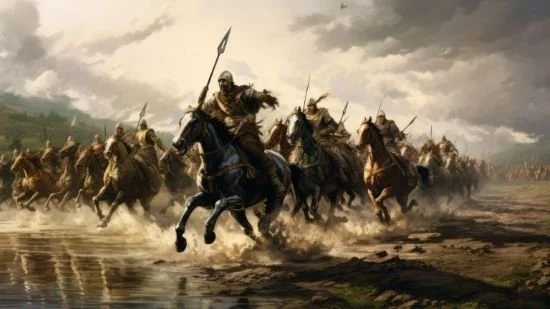
In light of yet another war raging in the Middle East–this time between the United States and Israel against Iran and its Revolutionary Islamic Government, appeal is made by dispensational prophecy pundits to the prophecy of Gog and Magog found in Ezekiel 38-39. Ezekiel supposedly predicted the war in Iran–as Greg Laurie claims in but one of a scad of recent YouTube pundits making the same claim.
In a time of fear and uncertainty brought about by war, it may be comforting to think that biblical prophecy is being fulfilled through these events—which can only mean that the rapture must be soon at hand. It is also a way to attract followers, get clicks, and sell books. People are worried and want answers. If pundits can claim this is the fulfillment of biblical prophecy, what can be more reassuring than that?
But this repeated use of Ezekiel 38-39 to explain the wars and rumors of wars in the Middle East has a number of serious interpretive weaknesses. What are these weaknesses? How has this prophecy been understood by dispensationalists in the past? And if the dispensational reading of the passage is not the correct one, how then should we understand the passage?
An Interesting History of Interpretation
Since the mysterious Gog and Magog are associated with a persecuting empire depicted in Ezekiel’s prophecy as being destroyed at the time of the end—the same holds true in the Book of Revelation (Rev. 20:8)—Gog and Magog have often been tied to the political powers which arise in conjunction with speculation about the future appearance of Antichrist.[1] Martin Luther once referred to the Ottoman Turks, then at the gates of Vienna, as Gog’s forces soon to come under the judgment of God.[2]
Dispensationalists of a previous generation equated the names that appear in this passage (Gog, Magog, Rosh, Meshech, Tubal, and Gomer, Ezek. 38:2–6 NASB) with nations of modern Europe in some sort of alliance with the Soviet Union (now the nations of the former Soviet Union). According to Hal Lindsey, Gog and Magog are supposedly tied to Russia (Rosh supposedly equals “Russia”) while Meshech is identified as “Moscow” and Gomer as “Germany,” all of whom will form an alliance with Ethiopia (Cush) and Libya (Put) and invade the modern nation of Israel, now back in the land, sometime toward the end of the seven-year tribulation.[3] But historian-archeologist Edwin Yamauchi thoroughly refuted the claim that Ezekiel is referring to the modern nation of Russia and the city of Moscow when the prophet uses these names.[4] His work was simply ignored by advocates of the “Russian Invasion” theory. “Hey Yamauchi, I’m trying to sell books here, don’t scare people off with the facts.”
To read the rest, follow the link below
Read More