Posts tagged Assurance
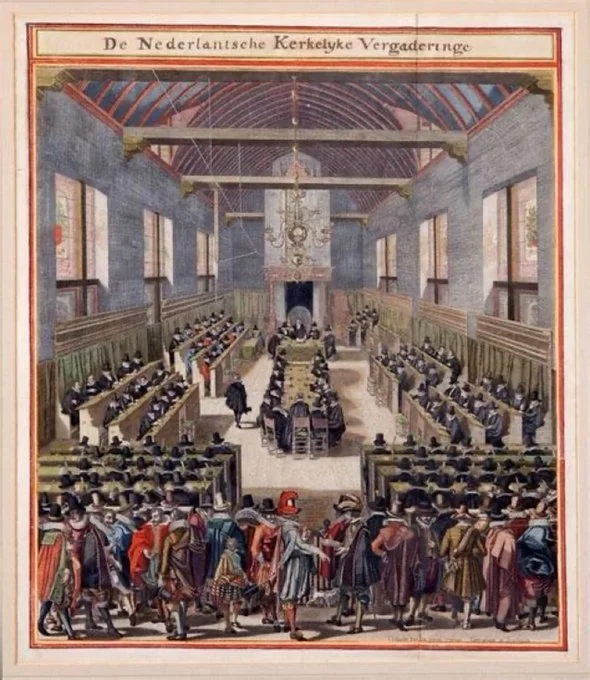
“No Assurance of Final Perseverance” — The Rejection of Errors, Fifth Head of Doctrine, Canons of Dort (5)

Having set forth the orthodox teaching, the Synod rejects the errors of those

Who teach that apart from a special revelation no one can have the assurance of future perseverance in this life.

For by this teaching the well-founded consolation of true believers in this life is taken away and the doubting of the Romanists is reintroduced into the church. Holy Scripture, however, in many places derives the assurance not from a special and extraordinary revelation but from the marks peculiar to God’s children and from God’s completely reliable promises. So especially the apostle Paul: “Nothing in all creation can separate us from the love of God that is in Christ Jesus our Lord” (Rom. 8:39); and John: “They who obey his commands remain in him and he in them. And this is how we know that he remains in us: by the Spirit he gave us” (1 John 3:24).

________________________________________

One of the things which should occur to us as we work through these refutations is that many of the errors of the 17th century Dutch Arminians are the same as those taught by the Roman church. In the Sixth Session of the Council of Trent (1547), we read the following. “As if it were true, that he who is justified, either cannot sin any more, or if he do sin, that he ought to promise himself a certain repentance; for except by a special revelation, it cannot be known whom God hath chosen unto Himself.” The Canons correctly identify the error here—the assurance of one’s final salvation cannot be known—a view held in common by Romanists and the Arminians. A doctrine isn’t in error merely because Rome affirms it, but the fact is that this error points us in the direction of a common ancestor to both Romanism and the Arminians in one branch of the Christian theological family tree—semi-Pelagianism.

Semi-Pelagians hold (with Roman and Protestant variations) that God’s grace is generic (non-specific) and available to all through an act of the will. Once such grace is “appropriated” (activated), it is now possible for those dead in sin to trust in Christ and subsequently be born again (regenerate). Regeneration follows from the exercise of faith. So, if the semi-Pelagian logic holds, since we obtain grace through an act of our wills, so too, we can lose regeneration through an act of the will. The need for this “fifth head” of doctrine to be promulgated by the Synod of Dort, makes it clear that this is the Arminian view—grace, and salvation can be lost.

To read the rest, follow the link below

Read More
“The Assurance of Salvation” -- Article Nine, The Fifth Point of Doctrine, Canons of Dort

Article 9: The Assurance of This Preservation

Concerning this preservation of those chosen to salvation and concerning the perseverance of true believers in faith, believers themselves can and do become assured in accordance with the measure of their faith, by which they firmly believe that they are and always will remain true and living members of the church, and that they have the forgiveness of sins and eternal life.

______________________________

Articles 4–8 of the Canons, which deal with perseverance and preservation, address the very real problem of indwelling sin and the temptation that all believers inevitably face. In Articles 9–13, the focus shifts to the believer’s confidence regarding the assurance (or certainty) of salvation. Yes, Christians need to be wary of a “fifth column” deep within: indwelling sin. We also must be careful to faithfully partake of the means of grace (the preaching of the Word and regular participation in the sacraments), since these are the basis of our spiritual strength and sustenance. As the Canons have emphasized, Christians are to flee from those things which we know can draw us away from Christ.

Despite the very real inner war against the flesh and the reality of our sinful nature, we need not live in fear that God will give up on us and cast us aside when we fall into sin or if we despair of our final salvation. True believers in Jesus Christ will persevere to the end of their lives in faith, because Christ preserves us in faith through his present intercessory work on behalf of all those chosen by the Father (the elect). This point is plain from 1 John 2:1–2, where Jesus is said to intercede on behalf of those for whom he has died: “My little children, I am writing these things to you so that you may not sin. But if anyone does sin, we have an advocate with the Father, Jesus Christ the righteous. He is the propitiation for our sins, and not for ours only but also for the sins of the whole world.” The source of our assurance, then, is Christ’s present work on our behalf in his offices of prophet, priest, and king. His intercession for us will cannot fail.

The Roman Catholic Church holds that the Reformed doctrine of assurance leads to the sin of “presumption”—i.e., the false sense that once justified, a believer can never fall away. This, it is claimed, inevitably leads to indifference toward our sin (The Council of Trent, Sixth Session, Article 9). Arminians, as we have seen, hold a similar view.

To read the rest, follow the link below

Read More