Coming Soon -- Michael Horton's New Book -- "Magician and Mechanic"
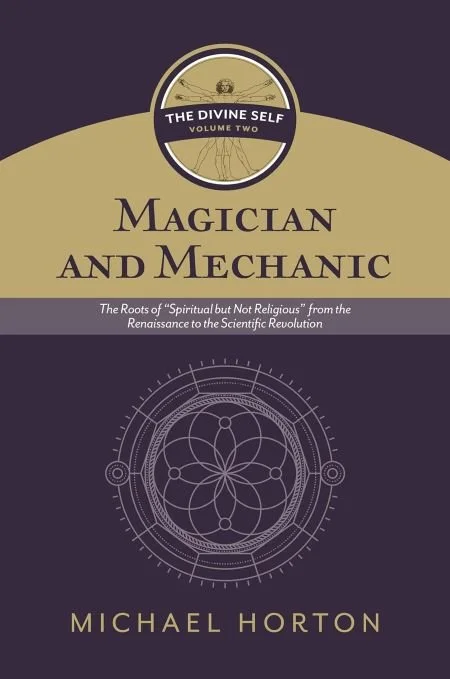
I am really excited about this one!
Why are American evangelical churches and progressive Protestant churches hemorrhaging membership? Why are these churches ignoring, downplaying, or renouncing distinctive Christian doctrine and ethics while striving to be “spiritual”? Why are the “nones” the fastest growing group in recent surveys of American religious affiliation? Why does your neighbor or your co-worker renounce “organized religion” in the name of “spirituality?”
Michael Horton addresses these matters in his series on the Divine Self, laying out the reasons behind this shift—those who embrace the divine self (likely without any awareness of doing so) will inevitably see themselves as “spiritual,” but not “religious.”
Horton’s series on the roots of “spiritual but not religious” is to my mind one of the most profound and important of recent efforts to determine why Western Civilization is becoming increasingly pagan. The first volume of a projected three volume series on the Divine Self (Shaman and Sage), was released in 2025, and dealt with the Axial Age (800-200 BCE) through to the Middle Ages, where the roots of modern forms of “spirituality” originate. Volume two (Magician and Mechanic) takes us from the Enlightenment, to the Renaissance, and then to the Scientific Revolution, addressing the challenges to orthodox Christianity as they develop in surprising ways throughout this period. Volume Three (which covers the modern period) will complete the series and is still TBA.
Shamen and Sage is an altogether profound book proving the old adage that there really is nothing new under the sun. I am very much looking forward to getting my copy of Magician and Mechanic and digging into the subsequent time period in an impeccably documented historical analysis.
Here’s the publisher’s blurb (Eerdmans)
In this second volume of The Divine Self series, Michael Horton explores changing conceptions of the divine self during the historic period from the Renaissance to the Scientific Revolution―a tumultuous era of rethinking humanity’s relationship to God and nature.
In Horton’s telling, this period is characterized not by steady diminishment of magic and orthodox religion and a corresponding rise of rational science, but rather by lively and productive interaction between these influences. Horton examines what is at stake for the divine self in this growing tension between magicians and Baconians, and what role each plays in the development of the modern self. He analyzes the work of renowned historical figures―Luther, Erasmus, Descartes, and Hobbes, to name a few―but also illuminates the activities of lesser-known individuals and groups that were profoundly influential in their time. From the gardens of Renaissance popes and dukes to Newton’s alchemical pursuits, life during this period is characterized by an intense search for the sacred and a desire for fullness―forces that lay the groundwork for the “spiritual but not religious” phenomenon as we know it today.
Magician and Mechanic occupies an important place in a monumental three-volume study of the divine self. The first volume surveys antiquity through the late Middle Ages; the third volume (forthcoming) will span the eighteenth century through the present day. When the series is complete, The Divine Self will stand as the authoritative guide to the “spiritual but not religious” phenomenon in Western culture.