But Then Again . . . You May Be the Antichrist
“Antichrist” as a Political Label
Calling your political foe the “Antichrist” has strayed so far from the biblical data that the practice has become flat-out ridiculous.
Once the political food fight—now a standard feature of countless podcasts and social media—began in earnest, it was necessary to find an unflattering label to slap on your opponent (or their tribe), so as to either marginalize them or tag them with an easily identifiable but obvious pejorative moniker.
Early labels were simply “left-wing,” or “right wing,” echoing the partisan labels based on where people sat in the French National Assembly during the Revolution. On the right, we heard the pejoratives used of Democrats and their supporters: “drive by media,” “libs,” and “environmentalist wackos.” Not to be outdone, the left managed to change the meaning of “conservative” (of which I am one, of the Reagan, limited government variety), into a term of derision. According to the liberal left, “conservatives” dislike minorities, women, reject science, are suspicious of progress, and renounce all forms of libertine sexual freedom and cultural expression. Conservatives are thought to be Bible-thumping backwater Christian fundamentalists (and almost always hypocrites) by the non-religious “others” who don’t know enough about Christianity to make any sort of accurate determination about what Christians actually believe and practice.
Then came Trump and MAGA. If you liked Trump, MAGA was doing the Lord’s work. If you didn’t like Trump, MAGA became something to decry as the identifier of all things detestable. The MAGA hat was now the ultimate declaration of one’s political fealty to Trump. To the left, wearing one was seen as an offensive insult needing to be ripped off the wearer’s head.
When the edginess of those labels wore off, both sides needed new “bad words” to define the other side. This whole process reminds me of the showdown between the two competing baseball teams in the beloved movie, The Sandlot. In a famous scene, the teams hurl insults at each other until one of them drops the bombshell, “you play ball like a girl.” There is no greater insult possible. There was nothing left to say. With the use of “Antichrist” as a political label, we have come to a similar dead-end.
The Democrats went from being called “liberals” to being labeled “woke” and haters of America. MAGA supporters were, in turn, called “racists” and “fascists.” The latter label was a feeble attempt to echo Hannah Arendt’s The Origins of Totalitarianism (which critiques both Hitler and Lenin). In the eyes of many on the left, MAGA was framed as a resurgence of fascism—with the embarrassing twist that many who used the term could not clearly identify its origins or historical meaning. Trump was compared to Adolf Hitler by those with little knowledge of actual Nazi atrocities, beyond recognizing Hitler as one of the worst figures in recent history; and so his name was thrown at Trump as just another in a series of escalating bad words.
But like all other attempts to demonize your opponents, labels lose their edge over time with frequent use. If “racist” no longer created the desired shame, if “fascist” lost its punch, and since calling Trump “Hitler” fails the historical smell test, as MAGA began to fracture, a new “baddest of all” label was needed for its leader by those now disenchanted and who left the movement.
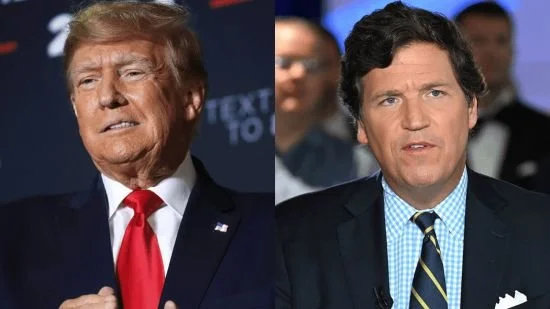
I don’t know who first dared to use the term “Antichrist” of Trump,[1] but once the sycophantic Tucker Carlson turned on the President, and the other pejoratives had lost their bite, it was only a matter of time before Carlson publicly identified Trump as “the Antichrist.” He wasn’t the first, he won’t be the last, but his affirmation has garnered the most publicity and caused the most outrage and consternation.
The Antichrist of Pop Culture and the Antichrist of Scripture
Let me be clear. These are not the same two individuals. The “Antichrist” of pop-culture is a figment of the imagination of filmmakers, novelists, and musicians, all of whom are looking for an occult angle to titillate and frighten consumers (so as to sell product, of course), while at the same time, making vague reference to the biblical figure about whom they know nothing about except that the designation “Antichrist” is found somewhere in the Bible.
Much of the pop culture “Antichrist” draws loosely upon widely-popular dispensational conceptions of the end-times, especially a supposed seven-year peace treaty with Israel, the cataclysmic Battle of Armageddon, and the nefarious use of AI technology to rule the world by preventing people from engaging in ordinary commerce (the latter associated with the Mark of the Beast). In his recent history of dispensationalism, Daniel Hummel makes an important distinction between a more scholarly variety of dispensationalism, and a “pop” version, devoted to end times punditry and speculation. While I am critical of the former, those who push the pop culture Antichrist (like Carlson’s slapping the label on Trump) co-opt the term from pop dispensational punditry and then further distort something already distorted.
There are three Antichrist threads in the New Testament, which, when considered together, make clear that any derivation of the “pop culture” Antichrist thrown about as a political label is a complete fiction conjured up by those who have likely never opened the pages of a New Testament nor have ever studied what Scripture actually says about our end-times foe.
It may come as a shock—if the advocates of the pop culture Antichrist even care at all—that the term “Antichrist” never appears in the Book of Revelation. It is only used in John’s epistles—and when it is used, it is in reference to first century heretics who possessed the spirit of Antichrist because they denied that Jesus was God in the flesh. In this vein, Jesus and the apostles repeatedly warn of false doctrine and false Christs. These kind of Antichrists have come and gone ever since. Therefore, I seriously doubt that Tucker Carlson means to call Trump a proto-Gnostic Christological heretic when he slaps the “Antichrist” label on him—although, from what we know of his understanding of Christian doctrine, Trump very likely has a deficient, if any, notion of biblical Christology.
Another “Antichrist” thread in the biblical data is the “Man of Sin,” to whom Paul the Apostle refers in 2 Thessalonians 2:1–12. This individual is a self-deifier who deceives the people of God through false signs and wonders, and whose appearance is tied to a time of great apostasy, followed by our Lord’s return at the end of the age. When Jesus returns, the dead are raised, all the inhabitants of the world are judged, and God ushers in a new heaven and a new earth. Although Christians debate whether the temple to which Paul refers is a rebuilt temple in Jerusalem (unlikely, in my opinion) or the church (more likely), this “Man of Sin” is presently being restrained. When the time comes for the Lord to lift that restraint, the people of God will face great persecution led by this individual, they will be subject to satanic deception, and have only this remaining hope: unless the Lord returns—and he will—God’s people would perish from the earth. So no, the political name-calling associated with the pop-culture Antichrist cannot even remotely be derived from Paul’s “Man of Sin.”
Then, there is the beast and false prophet of the Book of Revelation. In an obvious parody of the Trinity, the dragon (Satan) empowers the beast (the Roman state) and the false prophet (the successive Caesars and their henchmen) to wage war on the followers of Jesus. The crime committed by these Christians is to confess that “Jesus is Lord.” But that confession is at the same time a denial that Caesar is. The Roman Caesar (and those in his wake across time) hate the Christian confession of the Lordship of Christ and see it as a subversive threat to their tenuous power.
The obvious villain in John’s apocalypse is Nero, who put both Paul and Peter to death, and who may just be one of the most vile human beings who has ever lived—despite recent attempts by some historians to claim, “he wasn’t really that bad . . .” Although Nero met his end in 68 CE, his death is not the end of the story. In John’s vision, Nero’s evil presence becomes a picture for the people of God of the kind of rage-filled persecutors of the church who will arise throughout the inter-advental age, until a final Nero-like figure appears at the end of the age, only to be struck down by our Lord at his return and immediately cast into the Lake of Fire. When the Lord releases Satan from the abyss, this final Antichrist will appear. The situation will become so dire that no one then living could possibly entertain the thought that any American politician matches John’s description. This figure is evil incarnate, with no restraints until his final destruction, when, on bended knee, he too confesses that “Jesus is Lord.”
Therefore, the threat of a rising persecuting state (statism) and its leader (an Antichrist) is an ever-present concern for Christians—and one to which the label “Antichrist” might, in some cases, legitimately apply. But the biblical figure of the Antichrist (unlike the pop-culture version) is one who wages war against the people of God and succeeds in killing and persecuting many. Some Islamic groups (such as ISIS, the Islamic Republic of Iran, and Boko Haram) might fit that description, but the horrors wrought by this evil figure will occur on a much, much, larger scale. In that light, no American politician can, including the nearly eighty-year-old, term-limited, and fading Donald Trump.
So, enough already of the silly slapping of the pop-cultural “Antichrist” label on your political opponents. When you do so, you say far about yourself than you do about your opponent.
Resources on the Biblical Antichrist here at the Riddleblog
The Man of Sin (2006): The Biblical Doctrine of Antichrist: My 2006 book on the subject
A Case for Amillenialism: My 2013 book on the subject which includes biblical and historical data alluded to above.
Antichrist Speculation Is Nothing New: At the of the first millennium (850 CE) a French monk penned a treatise on the life and times of the Antichrist, which introduced or reaffirmed much of what Christians currently believe about our arch-foe.
Scoffers Will Come: You Can Bet on It: popular betting markets now include end times speculation
AI and Recent Antichrist Speculation: What do tech gurus think about AI and its ability to empower a pop culture Antichrist
Hitler as an Antichrist Figure: Hitler hated Christ, his church, and his people, He is an Antichrist figure.
666 and the Mark of the Beast: Why Antichrist is a present threat (not just future) to Christ’s church
The Binding of Satan: How can there be so much evil in the world of the devil is bound?
On the Staying Power of Dispensationalism: If dispensational pundits keep making predictions which don’t come to pass, why do people still follow them?
Louis Berkhof on the Historical Development of the Church's Doctrine of the Antichrist: Christians have thought about these things for a long time.
_______________________________
[1] There are several books making a case that Barack Obama was the Antichrist. The author of one of them sent me a copy since he quotes me favorably. Uh . . . thanks, but no thanks . . . the author shall remain nameless.