Wet Paint and Romans 7:7
I grew up at Knott’s Berry Farm—the famous amusement park in Buena Park, CA. My family owned and operated what surely was the only Christian bookstore in an entertainment venue like Knott’s. It was a great place to grow up and meet Christians from around the world.
Our store was located in two places. When my parents opened the store in 1955, it was located in what became Fiesta Village. In 1981, when much of Fiesta Village became “Camp Snoopy,” the Knott family graciously relocated us to the Grand Avenue shopping area, a few doors down from the famous Chicken Dinner Restaurant—a great location for business.
Both locations were adobe style buildings which were painted in Spanish mission colors (bright turquoise, with burnt orange trim and striping, on a tan background). Both buildings required periodic painting to look new and fresh—a feature of most amusement parks. At dawn, the Knott’s paint crews would scatter throughout the park and tackle the area to which they were assigned, working feverishly until the park opened a few hours later.
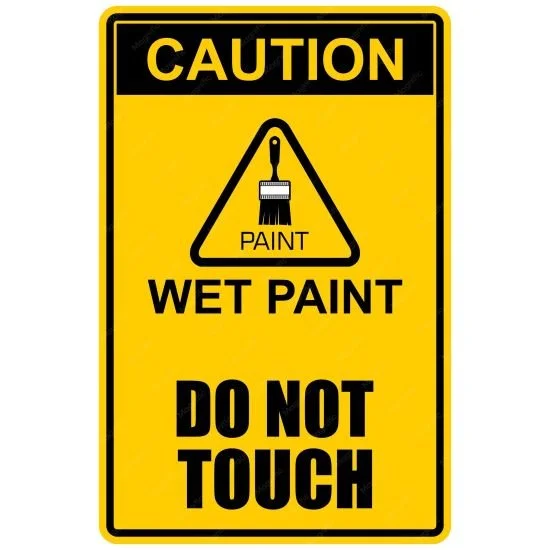
Since no one wanted guests to ruin their clothing, the painters posted “wet paint” signs with the added caution “do not touch.” The vast majority of days the walls near me went unpainted—no need to do so. No one (at least that I observed) ever reached out to touch any of the walls or surfaces. There was no reason to touch them. That is, until a “wet paint” sign, warning “do not touch” was posted immediately after the walls were painted.
Once the sign went up, hardly a group walked by in which someone did not go out of their way to touch the freshly painted area, only to look surprised when they got paint on their figure tips or hands. This happened over and over again throughout the years.
Why on earth would someone risk getting paint on their hands or clothing? If there had been no sign cautioning them, surely the thought would never once have entered their minds to touch wet paint.
Alas, Paul has the answer to this common human impulse. In Romans 7:7, he writes, “for I would not have known what it is to covet if the law had not said, `You shall not covet.’” No one would think to touch wet paint until a sign warned them not to. The sign which says, “wet paint, do not touch,” becomes the internal mantra “you must touch the paint . . . you must touch the paint . . .”
Paul is, of course, speaking of the law of Moses. But the law will do its work. Human rebellion extends to all kinds of things, including taking common sense warnings as rules to be broken. To paraphrase the apostle, “I was once alive apart from the law,” (when no one cautioned me about touching wet paint) “but when the commandment came, sin came alive and I died” (when I saw the sign, I got paint on my fingers and then ruined my clothes).