Warfield on the Mysticism of Evelyn Underhill (Part One) — Hint, He’s Not a Fan
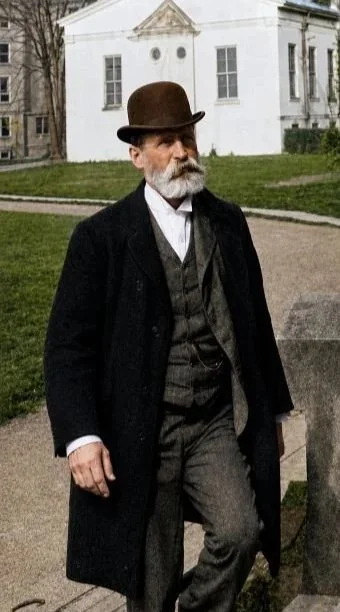
In the 1914 Princeton Theological Review, (105–123), B. B. Warfield published an in-depth review of four books written by Evelyn Underhill (1875-1941). Underhill, who was the author over 30 books, considered herself a “Christian mystic,” and wrote numerous books on the inner life, spirituality, worship, and several on mysticism. She is venerated on the liturgical calendar by several Anglican national churches, and her works are still read in a number of mainline Protestant, Roman Catholic, and even in some evangelical circles where religious experience is paramount and pursued.
If you know anything about B. B. Warfield, you know where this “review” is going. Warfield was, let’s just say, not a fan of Mrs. Underhill. As a scholar and a Kentucky-bred gentleman, Warfield was usually respectful, if tough on those who rejected the supernatural, historical, and miraculous elements of Christianity (i.e., miracles, the virgin birth, the veracity of the New Testament, etc.). When he reviewed several of her recent books in one lengthy review essay (which has been reprinted in The Works of Benjamin B. Warfield: Critical Reviews, vol. 10 (334-356), it is immediately clear that his patience with her work and influence has come to an end—the reason for his terse “review” of her efforts.
The four volumes from Underhill under review include:
Mysticism. A Study in the Nature and Development of Man’s Spiritual Consciousness (1911).
The Mystic Way. A Psychological Study in Christian Origins (1913).
Immanence. A Book of Verses (1912).
The Miracles of Our Lady Saint Mary: brought out of divers tongues and newly set forth in English (1906).
Warfield begins by recounting how Underhill’s previous and well-known novels reveal a number of her operating assumptions. The novels, “already reveal to us the intensity of her engagement with what is loosely called the mystical aspects of life, and no doubt embody, in an imaginative form, much of what she would consider symbolically at least wholesome instruction for our sense-preoccupied world" (334). In her novels . . .
Miss Underhill seeks her inspiration in preternatural [extraordinary] themes, and manifests a profound preoccupation with the supernatural, not to say the morbid, phases of life. From these novels alone we might assure ourselves that here is a writer who is ready to insist seriously that there are more things, not in heaven merely but here on earth, than are dreamed of in our starveling five-senses philosophy: and indeed that the most real things which surround us are not those which we touch with our clumsy fingers and gaze at with our dull eyes and taste with our gross tongues. It is not a matter of surprise that such a writer should come forward at length as a serious eulogist of Mysticism.
Warfield (good Scottish Common Sense Realist that he was) was not going to be impressed by anyone who sought religious knowledge in subjective and mystical experience rather than in touching grass (as the saying goes)—which means understanding Christianity not as an experience of something beyond our senses, but as a revelation from God in real history and which comes to us in a book of words and sentences (“God did,” and “God said” in and through the very historical person of Jesus of Nazareth). We Reformed folk speak often of “redemptive history” for a reason. We do not think of Christianity as something grounded in mystical experience of whatever we think the “divine” might be.
Warfield first takes up Underhill’s “giving new life” to Mary-Legends as expressed in her book, The Miracles of Our Lady Saint Mary. Warfield asks,
Speaking of the medieval attitude towards the Virgin she remarks upon the “simple and familiar friendship, mystical adoration, and unfailing trust” which were given to “Goddes Moder and oures” by those who, as she phrases it, “were in every sense her children.” And then she adds that it is “the aim of this book” “to drag back,” not only the “literary expression” of this sentiment “from the shadow-land to which it has retreated,” but the “sentiment” itself. May we infer that Miss Underhill has had, then, a directly religious motive in seeking to revive the knowledge of the Mary-legends?
And what might that motive be? Warfield notes how her work echoes that of a number of late 18th and early 19th century writers (now unfamiliar to us), but who sought an end-run around a view of Christianity anchored in history and which contained very specific doctrines, all tied to the person and work of Jesus Christ. Underhill’s work mirrors theirs.
It is not altogether easy to make quite sure of Miss Underhill’s precise religious standpoint. On the basis of her two solid works on Mysticism alone—which embrace her professed contribution to religious discussion—we might readily think of her as a Modernist Romanist. We do not suppose we do her injustice at any rate in imagining her in congenial society when in the company of, say, Friedrich von Hügel [an Austrian Roman Catholic apologist] or George Tyrrell [a convert from Anglicanism who became an Anglo-Irish Catholic priest and theologian]. Many of their points of view she certainly holds in common with them; some of their suggestions she works out in detail; and, if we mistake not, the ultimate issue of her religious thought is very much theirs—perhaps, we may add, in somewhat extreme expression. The whole argument of the work which is more especially in our mind as we write—“The Mystic Way”—might be represented as the detailed explication of a tendency apparent in von Hügel (it is no doubt present in more or less strength in all Mystical writers), to which Söderblom [a Swedish social-gospeler] calls sharp attention—the tendency, we mean, to think of Jesus as only a high-point in the religious development of humanity, which attracts the eye of men and to which we must also aspire, while there is withheld from Him all truly creative effects on the religious life of the world.
So, according to Underhill and those whom she exemplifies, what matters most is how Jesus serves as an example of the best in humanity, a man who lived an envious religious life, and a life which we ought seek to imitate. Where does this leave us? Warfield lowers the boom:
But [Tyrrell] seems to have meant it seriously when in the early days of the last year of his life he declared: “ . . . the Christianity of the future will consist of mysticism and charity, and possibly the Eucharist in its primitive form as the outward bond: I desire no better.” Perhaps even Mysticism no doubt seemed to him something less than solid ground: “Mystics think they touch the divine,” he explains in one of his moods of skepticism, “when they have only blurred the human form with a cloud of words” (336-337).
The precise effect of Miss Underhill’s discussion of “The Mystic Way,” in any event, is to place her in the same category with Houtin and Loisy and Tyrrell as here expounded. She reduces Christianity to simple Mysticism (337).
Mystical experience bridges all denominational distinctives and doctrinal differences. No serious appeal is made to biblical data, exposition of biblical passages, preaching of those texts, and the sacraments (i.e., bread, wine, water, and ink and paper—material things necessary to Christianity). In their place, there is only an appeal to aspire to be like Jesus, who in his own creative way, showed us the path to “touch the divine” through mystical experience.
The framing of Underhill’s mysticism and her compatriots by Warfield is now a century old. But the practice of subjective religion and the seeking of encounters with “touching the divine” live on with new trendy titles, celebrity practitioners, and mood-bending church architecture and staging, all designed so that attendees might have a vague, undefined, worship experience.
Then, as now, mystical religious experience unites people from diverse backgrounds and churches and provides common ground for those seeking theological justification for religious “diversity and inclusion.”
End of Part One — To be continued . . .