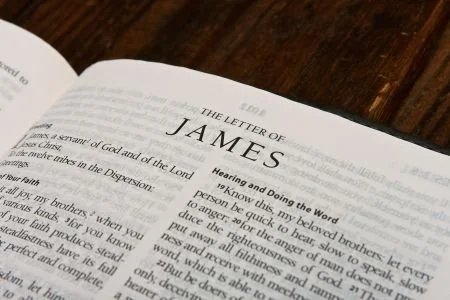
“The Tongue -- It Boasts of Great Things” The Sixth in a Series on the Book of James (James 3:1-12)
Fire–An Ever-Present Danger
If you live in Southern California, you are far too familiar with frightening scenes of wind-driven brush fires consuming everything in their path. When a brush fire strikes, vital watershed, expensive properties and homes are destroyed in minutes. People and animals are displaced, the skies turn black, and panic is the rule of the day. And yet as James reminds us, a more painful kind of damage can be done almost instantaneously by the human tongue. The words which we speak are capable of great destruction. Just as a small spark can create a horrific fire, our words can inflict great personal pain, or even destroy someone’s reputation which they’ve worked a lifetime to build. And then there is the fact that our words reveal how deeply and thoroughly sin resides in our hearts. The words which we speak reveal to everyone our deepest thoughts, they uncover our true character, and they expose how wise we may or may not be. A brush fire causes great havoc and damage. But the damage done by a fire often pales in comparison to the damage which can be done by the human tongue.
A Bit of Level-Setting
When we left off last time, we discussed one of the most controversial passages in all the Bible–James 2:14-26. In that passage, James makes his case that a living faith (i.e., a justifying faith) is a faith which inevitably manifests itself in good works. James has carefully set out the cause and effect relationship between regeneration, faith, and good works. In James 1:18, our Lord’s brother told us that God has brought us forth (regeneration) through the word of truth (the gospel). In verse 21, James speaks of how that same word has been implanted in our souls, inevitably giving rise to faith (James 2:1). Believers are to receive that word with meekness and humility. And that same word, which is able to save our souls is also to be obeyed. Says James in verse 22 of chapter one, “be doers of the word and not mere hearers only.”
In James 2:10, James tells us that the law of God exposes all of us to be sinners. If we break but a single commandment, we are as guilty as though we had broken every commandment. Sin but a single time and God regards us as law-breakers. And yet, Jesus Christ has fulfilled the law through his own perfect obedience to the Lord’s commandments. Because Jesus Christ has died for all of those times we have failed to keep the law, for the Christian, the law is now described as a “law of liberty.” As James puts it, the Christian who gazes upon the law perseveres during trials. Such a person is a doer who acts. But the one who only hears, but does not do, is like someone who looks at himself in a mirror and then immediately forgets what he looks like. The law exposes sin, reckons people law-breakers, and smokes out those who are mere hearers of the word only. When such people make a profession of faith in Christ, that profession is not accompanied by good works. They may claim to follow Christ, but give no hint of actually following him. They “hear” but they do not “do.”
When it comes to the matter of justification, James is answering the question “how can we tell if someone’s faith has justified them?” Says James, “show me your faith apart from works, and I will show you my faith by my works.” Genesis 15:6 tells us that Abraham believed God, and Abraham was reckoned as righteous before God (justified). But as James points out, Abraham’s “faith was active along with his works, and his faith was completed by his works” (v. 22). James’s point is that the faith which justifies is a living and active faith which, in turn, produces good works. This is what James is getting at when he says “you see that a person is justified by works, and not by faith alone” (v. 24). If someone claims to have faith in Christ, but gives no evidence (good works) of struggling to obeying God’s commandments, then whether or not they have truly trusted Christ remains an open question.
What Doers of the Word Are to Do
Having told his reader why good works are the necessary fruit of a justifying faith, James now begins a discussion of how true religion is manifested in the life of a Christian. In chapters 3-5, James addresses a number of topics. In the first twelve verses of chapter 3, James speaks of the destructive power of human speech (the tongue). This is our topic in this exposition. Then in verses 13-18 of chapter 3, James addresses the importance of seeking divine wisdom and the need to cease relying upon human wisdom. In chapter 4, James warns his reader of the danger of worldliness–in this case, fighting, quarreling and speaking evil of one another–before going on to warn his readers not to boast about tomorrow when they don’t know what tomorrow actually holds. James will then warn the rich not to trust in their riches, he exhorts his persecuted readers to be patient in the midst of their suffering, before closing the letter with a treatment of the prayer of faith. According to James, these are the acts of a pure and undefiled religion.
While the first two chapters of James have a logical order (as James explains the cause and effect relationship between the word, faith, and good works–the word is the cause of faith and works are the effect of faith–the final chapters of James presuppose what is said in the first two chapters. At first glance there is not really a discernible order to the topics which James addresses. Perhaps the best way to understand the final three chapters simply is this–these are pressing issues in the churches to which James is writing. All of the matters touched upon by James are probably things which are beginning to fester and create problems in the churches of the dispersion. This is why James’s exhortations are so direct, and contain no explanation, which, apparently, was not needed.
That this is likely the case can be seen in verses 1-3 of James 4 when James speaks to some of the issues plaguing the churches.
What causes quarrels and what causes fights among you? Is it not this, that your passions are at war within you? You desire and do not have, so you murder. You covet and cannot obtain, so you fight and quarrel. You do not have, because you do not ask. You ask and do not receive, because you ask wrongly, to spend it on your passions.
If this kind of quarreling was even then going on within the churches, James’s exhortation to be doers of the word and not hearers only is realized when God’s people tame their tongues, seek wisdom from above, avoid worldliness, stop boasting about the future, stop trusting in riches, and when they ask God in faith for all good things.
Our Speech Reveals Our Secrets
As someone once put it, “words are also works.”[1] Given all that we’ve read in the Book of James so far, it should come as no surprise that at some point in this epistle James would tackle the subject of our speech to one another other, and in doing so, James cautions us of how destructive our words can be, and why we need to struggle to tame our tongues.
James does not pick this subject of human speech and the damage it can do out of thin air. James has just given us a rather direct argument that our faith is justified (vindicated) by our good works. Since James’s words often echo the teaching of Jesus, one passage which may lie behind James’s discussion here is one of our Lord’s sayings in which Jesus directly ties our speech to our justification/vindication. In Matthew 12:37 Jesus states “for by your words you will be justified, and by your words you will be condemned.” It sure sounds like James is virtually echoing these words from Jesus. If our good works are the vindication (justification) of our faith, and Jesus specifically ties this to our speech, then it would only be natural for James to do the same thing.[2] The nature of our speech must reflect our profession of faith in Christ.
When we consider Jesus’s teaching elsewhere in Matthew’s gospel about the connection between the sinful human heart and the tongue, we see why James addresses this topic as he does. After calling the Pharisees a “brood of vipers!” Jesus goes on to ask them, “how can you speak good, when you are evil? For out of the abundance of the heart the mouth speaks.” The human heart is filled with sin. But we cannot see into the human heart where sin lies hidden. While we readily accept the fact that we cannot see into someone else’s heart, what we have to understand is that we are not very good at evaluating the condition of our own hearts. It is hard for a sinner to objective when evaluating their own sinful hearts!
But Jesus makes it perfectly clear that one of the best windows into our own sinful nature is our speech. What we say often reveals what would otherwise remain hidden deep in our hearts. In the next few verses, James is making much the same point as Jesus. Our speech gives it away–we really are sinners, no matter how well we disguise it. As Ben Franklin says in Poor Richard’s Almanac, “it is better to be thought a fool than to speak and remove all doubt.” The same thing applies to the connection between our sinful nature and our tongues. How often do our words expose what otherwise lies hidden inside? How often do our words prove that the Bible accurately portrays human nature (indeed our own nature) as sinful? How easily do our words come forth, even though they do great damage to others?
Speech and Wisdom
Given the connection between our speech and what we truly are inside, this explains why Jews considered one important indication of the depth of someone’s wisdom to be whether or not they knew when and where to remain silent. Throughout the Old Testament (especially in the Book of Proverbs) godly speech was considered a manifestation of someone’s faith and wisdom. Likewise, Proverbs tells us that ungodly speech reveals the true state of the human heart. Take Proverbs 10, for example. In verse 8, we read, “the wise of heart will receive commandments, but a babbling fool will come to ruin.” In Proverbs 11:9, the author states: “With his mouth the godless man would destroy his neighbor, but by knowledge the righteous are delivered.” And then finally, in Proverbs 12:18, the author tells us that “there is one whose rash words are like sword thrusts, but the tongue of the wise brings healing.” No doubt, this capacity of the human tongue to reveal what is hidden in our hearts, as well as to bless and to curse, is an important theme in the wisdom literature of the Old Testament.
And so as we turn to our passage, it is pretty clear that James not only draws upon the words of Jesus, but he is also drawing from the Wisdom literature of the Old Testament. As James moves into his discussion of how “hearers” should “do,” James seems to be aiming his words at teachers. But while James may begin with teachers, we need to understand that James is not limiting his discussion to teachers only. As we go through the passage, we will see that James’s words apply to all of us, including teachers.
In verse 1, James writes “not many of you should become teachers, my brothers, for you know that we who teach will be judged with greater strictness.” Before tackling the destructive nature of the tongue, James begins by warning teachers that any who presume to teach will be judged by God with a greater strictness. In James’s day, a teacher would have been someone like a Rabbi, who was charged with the task of teaching from the Scriptures–in this case, the Old Testament, since none of the New Testament was yet written, although the apostolic church also relied upon the memorized sayings of Jesus.[3]
By using the plural here (“we”) James considers himself as a teacher, and therefore someone also held to this higher standard. Indeed, James warns anyone who presumes to teach to be fully aware that they will be held to a higher standard than those who are being taught. This warning stems from the fact that the responsibility to teach correctly is great, because to teach incorrectly about the gospel has such serious consequences upon the hearers–leading people astray from the truth and to a false confidence in human righteousness. All of us who teach must weigh this warning very carefully, and not enter into a teaching ministry unless called by the church, and only after our internal call is verified through an external call from the other office-bearers in the church. Just think of how much damage has been done by those who think they are called to teach, but who are not.
Bridling Our Tongues
In verse 2, James moves beyond those who teach, to address all Christians, noting that all of us stumble because of our inherent sinfulness. “For we all stumble in many ways. And if anyone does not stumble in what he says, he is a perfect man, able also to bridle his whole body.” James’s point is that since we all stumble, we are prone to imperfection, and we will inevitably struggle bridling (controlling) our behavior. Yes, James exhorts us to be “doers” and not “hearers.” But James is not a perfectionist. James exhorts us to tame our tongues (he expects us to do so), but he also realizes that we are all sinners who will inevitably stumble, revealing ourselves to be law-breakers. It is only the Christian (who is already justified by faith) who is able to “do” what they “hear.” Even then, says James, every Christian will stumble. But despite continually stumbling, the Christian will struggle to tame their tongue.
Beginning in verse 3, James offers a series of illustrations designed to prove the power of the tongue and how such a seemingly insignificant body part, can exercise so much destructive power. The first illustration James uses is that of a horse’s bridle. “If we put bits into the mouths of horses so that they obey us, we guide their whole bodies as well.” A horse is a powerful animal, but a small bit in a horses’ mouth can direct the whole animal. The same holds true for a ship. “Look at the ships also: though they are so large and are driven by strong winds, they are guided by a very small rudder wherever the will of the pilot directs.” In James’s day, most ships depended upon the power of the wind, although certain warships utilized slaves to row the vessel at a higher speed in times of battle. But even a great ship is steered by a very small piece of wood–a rudder.
Having given us these wonderful illustrations, in verses 5-6, James laments, “So also the tongue is a small member, yet it boasts of great things. How great a forest is set ablaze by such a small fire! And the tongue is a fire, a world of unrighteousness. The tongue is set among our members, staining the whole body, setting on fire the entire course of life, and set on fire by hell.” In the ancient world a forest fire was an impossible foe. There were no fire-breaks, firefighting aircraft, or fire-engines. People were totally at the mercy of such a fire, driven by the wind and limited only by the amount of available fuel.
The Untamed Tongue Can Cause Great Destruction
So it is with the tongue. It sets people’s lives and reputations on fire. It manifests a world of unrighteousness–the very opposite of the righteous verdict given us in justification. The tongue makes great boasts about human greatness and our supposed independence from God. What we says stains our whole bodies, as well as staining others with falsehoods. The tongue is a very small organ, but one which can reveal like nothing else just how sinful we are. The unbridled tongue can destroy true religion. It can be so destructive that is can set one’s entire life on fire. No doubt, James is here alluding to Gehenna (Hell–the Valley of Hinnon), the place outside the city of Jerusalem where the cities’ trash was burned, and where the pagans had earlier sacrificed their children to Molech.[4]
James is reminding us that our speech can be far more destructive than a fire. Our speech can do great emotional damage. Our speech can inflict great emotional pain. In fact, our speech may do more damage and cause more pain and suffering than a physical injury can cause. In many cases, our bodies heal much faster than our souls. Our tongue boasts. It destroys. It stains. It reveals. It starts fires.
Having made clear how destructive the tongue can be, in verses 7-8, James readily acknowledges how difficult it is for us to control it–even as Christians who are “doers” of the word. “For every kind of beast and bird, of reptile and sea creature, can be tamed and has been tamed by mankind, but no human being can tame the tongue. It is a restless evil, full of deadly poison.” Drawing upon the creation account, James reminds his audience that God gave to Adam dominion over all the creatures–Genesis 1:26 reads “then God said, `Let us make man in our image, after our likeness. And let them have dominion over the fish of the sea and over the birds of the heavens and over the livestock and over all the earth and over every creeping thing that creeps on the earth.’” Animals–except for the common house cat–can be tamed because humans are given dominion over them. But the tongue cannot be controlled. Bits control horses. Rudders control ships. Humans can tame animals. But no one can tame the tongue.
The reason why this is the case is because the tongue audibly reveals what is hidden in the human heart–and our hearts are filled with evil. Because our tongues spew out the sinful venom that is within us, James can call the tongue a “restless evil.” Why? Because what we say proves what we are. And what we say is “full of deadly poison.” What we say has the power to harm, every bit as much as poison has the power to make someone sick. No question that James is echoing the words of Psalm 140:3, cited by Paul in Romans 3:13. “They make their tongue sharp as a serpent's, and under their lips is the venom of asps.” While James’s reader has dominion over the creatures, they have no such dominion over their own tongues. Such is the depth and power of human sin, which remains even in the hearts of Christians.
The Tongue Blesses and Curses
As James goes on to point out in verses 9-10, the great paradox of human sin produces the circumstance in which “with it [the tongue] we bless our Lord and Father, and with it we curse people who are made in the likeness of God. From the same mouth come blessing and cursing.” In this we see the fact of indwelling sin. Apart from God bringing us forth by his word (causing us to be born again through the preaching of the gospel), we would have no interest in praising God. But those whom God has brought forth use their tongues to praise God who has rescued them from death and certain judgment. And yet, even though God has brought us forth, implanted his word with us, justified us by faith apart from works, and then justified our faith by our works, indwelling sin remains. Even as we praise God, we still curse those whom he made, those who are also created in the divine image. This is the spiritual schizophrenia of fallen human nature. On the one hand, we praise God. On the other, we curse our neighbor. James can lament about this condition, “My brothers, these things ought not to be so.”
When James speaks of men and women as bearing the likeness of God, it is vital to notice that James makes this reference in regard to fallen men and women. This means that even after our race fell into sin, all people are bearers of the divine image. This is the exact same thing we find in Genesis 9:6, where the reason why the taking of a life is such a serious offense against God is because men and women bear the divine image–even after the fall of Adam.
Not only does the divine image include dominion over the animals, it entails things like the communicable attributes of God (as creatures, we are like God in every way that a creature can be like God–and yet forever unlike God because we are creatures), it includes our reason, our moral nature, and our natural affections and emotions. The divine image defines what it means to be human and this separates us from the creatures.
This is why naturalistic evolution is such an offense to Christianity–it is a direct attack upon the idea that men and women bear the divine image, and reduces us to mere creatures (animals), when God has declared us to be created in his own likeness. It is rather remarkable to me that when humans rebel against God, and then declare their independence from their creator, they then reckon themselves as mere animals. All the while, the Bible, which they reject, instead speaks of every human being created but a little lower than angels (Psalm 8:5). Scripture reminds us that we are fearfully and wonderfully made (Psalm 139). It is truly remarkable that God assigns this dignity to all men and women, and this is why it is so wrong to curse our neighbor. No matter how we may perceive our neighbor, they still reflect the divine image. And if we curse them, we are cursing the work of God.
The Application – What Kind of Speech?
In verses 11-12, James now asks several more rhetorical questions, further pressing home his primary point. “Does a spring pour forth from the same opening both fresh and salt water? Can a fig tree, my brothers, bear olives, or a grapevine produce figs? Neither can a salt pond yield fresh water.” And yet, sadly, we are so double-minded, we praise God and still curse our neighbor. We cannot tame our tongues, yet we still must make every effort to do so. While our tongue boasts of great things, it reveals how little we have to truly boast about. This, of course, is the great paradox of sinful human nature. Doers of the word must realize that despite the seemingly impossible struggle to do so, we must tame our tongues, because our tongues can do so much damage to others.
Beloved, our words can do great damage. Our tongues set fires that do unspeakable harm to those we love most, or know the least. Although at times our cruel words are premeditated (and calculated to do maximum damage), other times our words of destruction flippantly cross our lips often before we even know what we are saying. In both cases, our speech not only reveals that we are sinners at the very core of our being, but our words can do more damage than we could ever imagine.
The only hope for any one of us is to be found in a gracious Savior, who not only has suffered and died for all of those times we have used our tongues to curse God and our neighbor, but a Savior who never once spoke in such a way as to boast about himself, or to demean another. The only person who ever lived who loved God and neighbor as he should is Jesus. The only person to tame his tongue is our Savior. While James expects us to struggle to bridle our tongues, he also speaks openly of the difficult struggle to do so. James understands the inevitability of the fact that at many points in our lives, our tongues will betray the depth of that sin that lives inside of us. James is not a perfectionist. He knows that our speech will give away who and what we are. But because the tongue is so lethal, James exhorts us to make every effort to tame it.
How do we do what seems so impossible? For one thing, James reminds us that those whom we curse are divine image-bearers. Keeping this in mind is one of the most important ways to restrain our tongues. If we stop and recall that the person we curse bears the image of God, we’ll be less likely to curse them. And then we need to keep before us the knowledge that our blessed Savior never once uttered a cruel word, or told a falsehood about his neighbor. This why we must constantly be reminded that Jesus suffered and died for all the times we’ve cursed our neighbors, and because his perfect speech is reckoned to us, we must continually ask ourselves, “how then can we go on cursing our neighbor without taming our tongues?” Yes, the tongue boasts of great things, and it starts horrible emotional fires. But in light of the mercies of Christ, we must use our tongues to praise God and bless our neighbor. We must make every effort not to curse or slander others. This is what it means to be a hearer of the word, and a doer of the word.
_________________________________
[1] R. V. G. Tasker, cited in Moo, The Letter of James, 147.
[2] Moo, The Letter of James, 147.
[3] Moo, The Letter of James, 149.
[4] Moo, The Letter of James, 159-160.