
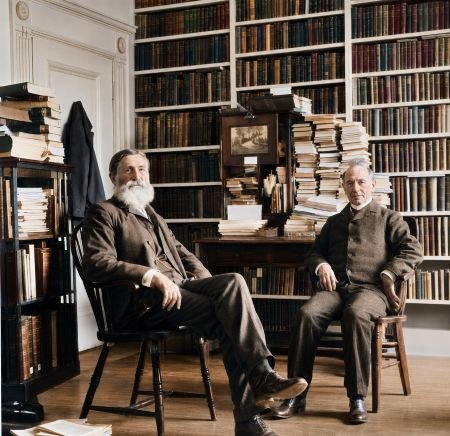
This is taken from a 1915 article, the "Person of Christ" which was first published in The International Standard Bible Encyclopaedia, edited by James Orr. It is found in volume 4, pp. 2338-2348, and well-worth reading in its entirety. This essay has been reprinted in The Person and Work of Christ, ed John J. Hughes, published by P & R (2025), 37-74.
Warfield is describing the two natures of Christ as forth by Paul in Philippians 2:5-9. He calls attention to the fact that,
It should be carefully observed also that in making this great affirmation concerning Our Lord, Paul does not throw it distinctively into the past, as if he were describing a mode of being formerly Our Lord's, indeed, but no longer His because of the action by which He became our example of unselfishness. Our Lord, he says, "being," "'existing," "subsisting" "in the form of God" - as it is variously rendered. . . . Paul is not telling us here, then, what Our Lord was once, but rather what He already was, or, better, what in His intrinsic nature He is; he is not describing a past mode of existence of Our Lord, before the action he is adducing as an example took place - although the mode of existence he describes was Our Lord's mode of existence before this action . . . . He is telling us who and what He is who did these things for us, that we may appreciate how great the things He did for us are.
Warfield regards our Lord’s role as messianic servant as key to Paul’s point of application being made to the Philippians. According to the Princetonian, Christ’s divine nature is not “was” or “will be,” but “is.”
To read the rest follow the link below
Read More