
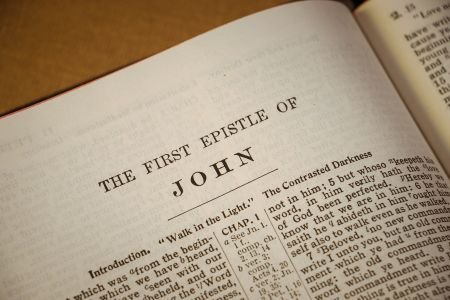
The Incarnation of Christ – the Foundation
John has written a rather impassioned defense of our Lord’s incarnation–Jesus is eternal God manifest in human flesh. Throughout his first epistle, the apostle has reminded us that the reason why Jesus came to earth was to save us from our sins. Our Lord’s incarnation is no mere curiosity. Our salvation depends upon it. But the sad fact is that through the efforts of false teachers, a number of people in and around Ephesus (where John was the last living apostle) had become convinced that while Jesus was truly God, he only took the form of a man. John calls this destructive false teaching the spirit of antichrist (1 John 4:3). This is known as the docetic heresy and it completely undermines the apostle’s testimony about Jesus. This heresy also completely undermines John’s gospel. If Jesus is not truly human, as well as fully God, then we are still in our sins. For John’s reader, the truth of Christianity stands or falls based upon the truthfulness of John’s testimony about Jesus, whom John claims to have seen, heard, and touched.
As we conclude our study of 1 John, we will make our way through the closing verses of chapter 5 (vv. 13-21). While John brings this letter to a close, he continues to emphasize the same theme which dominates this epistle’s final chapter–a believer’s assurance of God’s favor toward them in Christ. In order to assure Christians of God’s favor toward them, John continues to flesh out his basic point about knowing–“how do we know that we know?” This is an especially important question in light of the fact that the false teachers plaguing the churches to which John was writing, were claiming to “know” certain things about Jesus which previously were hidden or secret. They were claiming (in light of this secret knowledge) that Jesus was not truly human.
John’s readers faced a choice. Do they believe the testimony of John? Or do they accept this secret teaching which contends that since matter was intrinsically inferior to pure spirit, God could not take to himself a true human nature (a material body), and that Jesus, who was truly God, only appeared in the form of a man, much like someone puts on a costume. This, supposedly, accounts for Jesus’s physical appearances in the gospels.
John Is a Witness to the Incarnation
This conflict explains why John opens this epistle with a truth claim grounded in his own experience and his testimony about Jesus. Jesus is God manifest in the flesh. John testifies to the truth because he saw Jesus, heard Jesus, and touched Jesus. Indeed, this is what all the apostles taught (i.e., why we call it the “catholic” or universal faith), and this is that truth to which the Holy Spirit will bear witness just as Jesus had promised before he ascended into heaven. Therefore, the question of how a Christian “knows that they know,” along with the assurance they have of God’s favor toward them in Christ, becomes a very important matter–especially in the presence of those who claim to have “knowledge” which contradicts the testimony of John. How do we know the basic Christian claim that Jesus is God manifest in the flesh to be true? Can we be assured of God’s favor toward us, without being careless and presumptuous?
Not only does John deal with these issues in the final chapter, he has several other points to make as he wraps up. In verse 13 we find a summary statement about why John composed this epistle, while in verses 14-17 John speaks of prayer, especially of the importance of praying for those who have fallen into serious sin. In verses 18-20, John reminds us of God’s gracious protection of those whom he has brought from death to life. The apostle also reminds us of the fact that we can indeed truly know we are Christ’s, and that through Christ we have fellowship with the Father. And then in verse 21, John closes with a brief reminder about the dangers of idolatry–something especially important to Christians living in and around Ephesus, a city dominated by the Temple of Diana.
To read the rest, follow the link below
Read More