
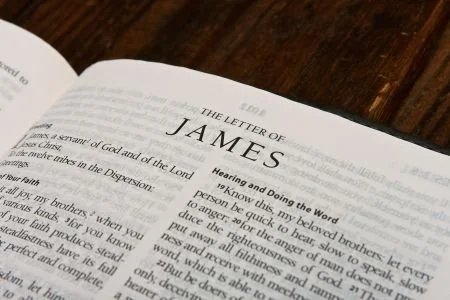
James Versus Paul – A Needless Controversy
It would be hard to find a passage of Scripture which is more controversial than James 2:14-26. The reason for the controversy is James’s assertion in verse 24 that “a person is justified by works and not by faith alone.” This seems to fly in the face of a number of passages in Paul’s letters where Paul appears to be saying the exact opposite thing. Take, for example, Galatians 2:16. “Yet we know that a person is not justified by works of the law but through faith in Jesus Christ, so we also have believed in Christ Jesus, in order to be justified by faith in Christ and not by works of the law, because by works of the law no one will be justified.” Those who believe that the justification of sinners is a process which is not complete until death (Rome), view James’s remarks here as a classic proof-text which supports this view. Rome and its allies claim that Justification is by faith plus works, or through the merit of the works faith produces. They claim that Paul’s comments about justification must be understood in the light of James 2.
But those who see justification as an instantaneous declaration made about the sinner because the merits of Christ’s life, death, and resurrection are imputed (or credited) to them through the means of faith, can appear to stumble over James’s declaration that works are somehow tied to justification, and that we are not justified by faith alone. But as we will see, James and Paul do not contradict each other. In fact, when James’s assertion is put in its proper context, there is nothing whatsoever in James 2 which conflicts with the doctrine of justification sola fide.
In this series, we have been making our way through the opening two chapters of the Epistle of James, and we now come to the second half of James chapter 2. I have mentioned throughout our series that this section of James is somewhat of a sore spot to confessional Protestants who champion Paul’s doctrine of justification. One reason for this is because when addressing justification, the Canons and Decrees of the Council of Trent (Canon X)–Rome’s official response to the Protestant Reformation–teach that justification is a day to day process, depending upon how effectively people submit themselves to God’s grace so that they increase their justification over time, and hopefully, attain final justification. James 2:24 is cited by The Council of Trent as a proof-text supporting Rome’s view that justification is a process connected to the merit of our good works.
Granted, at first glance, James seems to be saying something quite different than Paul. And those who oppose the Reformation doctrine of justification often seize upon comments made by James in this chapter to prove that we are not justified by faith alone, but that we are justified by faith plus continual inward transformation, and the performance of good works which merit (earn) a reward from God.
To read the rest, follow the link below
Read More