
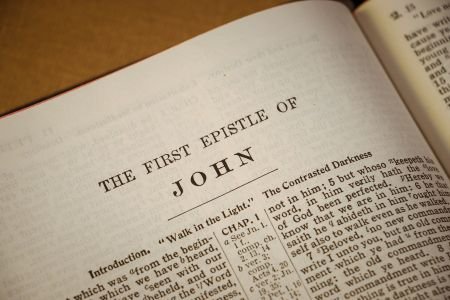
False Teachers Have Arrived
In his first epistle, John is defending the doctrine that Jesus is God manifest in the flesh against a group of false teachers who have departed from the truth by teaching that Jesus was not a flesh and blood Savior, but a deity who merely appeared in the form of a human. John calls this teaching–which is known to us today as the heresy of docetism–the spirit of antichrist (2 John 1:7). For the apostle, Christianity is not a religion in which one learns a set of secret principles revealed to a few enlightened individuals who have managed to gain insight into the “real” teaching of Jesus. For John, Christianity is a religion grounded in the historical work of a flesh and blood Savior (Jesus Christ) whom John has heard preach, whom John witnessed perform miracles, and whom John even touched with his own hands.
To deny that Jesus is truly human is to deny the truth of Christianity. Given the importance of this point, John once again returns to a discussion of the nature of the Christian truth claim, and warns his readers yet again of false teachers and antichrists, who will inevitably come and attempt to deceive God’s people. But John does more than merely warn us about these false teachers, he gives us a test to determine whether or not someone has imbibed from the Gnostic heresy–“does a teacher confess that Jesus is God in human flesh?”
Yet Another Warning
As we have been working our way through John’s epistles, we now come to the fourth chapter of 1 John. John is returning to issues in chapter 4 which he’s already addressed in the first three chapters. John likely does this for the sake of emphasis. In chapter two John had emphasized the need for Christians to obey God’s commandments, to reject worldliness (the non-Christian way of thinking and doing), and to heed his warning about the presence of many antichrists in the age in which we now live.
In chapter three, John repeats these themes while emphasizing different aspects of them. For example, not only must God’s people strive to obey his commandments, we are no longer to be characterized by the practice of sin. Furthermore, Christians will strive to love their brothers and sisters in Christ, while rejecting the murderous ways of Cain, who is the epitome of worldliness, and whose indifference toward God (i.e., his produce offering) and hatred of his brother Abel (whom he killed) prefigures those whom John describes as antichrists.
These false teachers, says John, deny that Jesus is God in the flesh. They seek out “esoteric,” secret truths about God, and they deceive themselves into thinking that they have somehow risen above sin. This explains their indifference to God’s commandments and their lack of love for both God and his people. They may claim to have gained “wisdom,” but John has repeatedly exposed them to be theologically clueless, which is a very serious and dangerous place to be.
Spiritual Darkness and the Appearance of Antichrist
In chapter two, John tells us that the difference between these two groups (Christians and those taken in by the false teachers) is as plain as the difference between light and darkness. In chapter three, John says the contrast between the two groups is apparent in the fact that Christians struggle against sin, while the proto-Gnostics do not. Now, as we make our way into chapter four, John stresses that the contrast is also made plain through someone’s confession about Christ. In this case, the truth claim is very specific. “Is Jesus God manifest in the flesh, or is he not?”
Recall that in verses 18-25 of chapter two, John introduced the figure of antichrist. As we saw when we worked through that portion of this epistle, according to John, many antichrists have already come. In 1 John 2:18-22, the apostle writes:
Children, it is the last hour, and as you have heard that antichrist is coming, so now many antichrists have come. Therefore we know that it is the last hour. They went out from us, but they were not of us; for if they had been of us, they would have continued with us. But they went out, that it might become plain that they all are not of us. But you have been anointed by the Holy One, and you all have knowledge. I write to you, not because you do not know the truth, but because you know it, and because no lie is of the truth. Who is the liar but he who denies that Jesus is the Christ? This is the antichrist, he who denies the Father and the Son.”
If an antichrist is someone who proclaims a message which denies that Jesus is the Christ (God manifest in the flesh), and if the very presence of these antichrists is characteristic of the last hour (the final period of human history), then the conclusion we must reach is fairly obvious. The final period in human history began with Christ’s ascension into heaven. We live in that same period of redemptive history as did John’s original audience. And just as the Christians in Ephesus (to whom John is writing) did combat with these antichrists, so must we. And while too many of our contemporaries have interpreted John’s message through the distorted lens of modern dispensationalism–antichrist is the one who makes a peace treaty with Israel at the start of the seven-year tribulation period and will attempt to brand everyone with the mark of the beast, the mysterious 666–John’s test for the presence of an antichrist is rather different. What does someone confess about Jesus Christ? Do they confess that Jesus is God manifest in the flesh? Or do they claim that Jesus is God who merely took the form of a man (like someone putting on a costume and playing a role) but was not truly human (with real flesh and blood).
To put it another way, Christianity is founded upon a particular set of historical facts. Did God truly take to himself a true human nature in the person of Jesus of Nazareth? Did that same Jesus, who was true and eternal God and true man, suffer and die for our sins, offering up a propitiatory sacrifice which turns aside God’s wrath toward our sins? Did that same Jesus rise bodily again from the dead and ascend into heaven where he presently intercedes for us as our advocate with the Father? If he did, then Christianity is true whether someone believes it or not. If he didn’t, then Christianity is false, no matter how many Christians believe it to be true.
To read the rest, follow the link below
Read More