
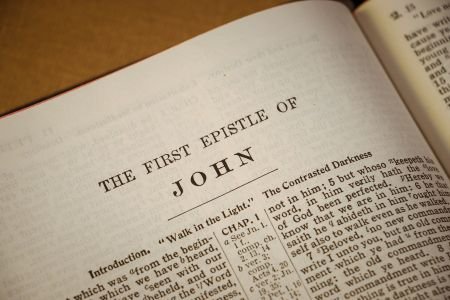
God Is Light
The contrast between Christianity and false religion is as apparent as the contrast between light and darkness. John the Apostle must deal with certain men who had departed from the faith and who were now denying that Jesus is God manifest in the flesh. To expose their errors, John uses a simple contrast. God is light. Darkness cannot exist in his presence, because light casts out darkness. Since Jesus Christ is God manifest in the flesh, Jesus is that light which has come into the world. That light which gives life, enables God’s people to walk in the light, even as Jesus is the manifestation of the light. And since light casts out darkness, so too Christ’s coming in the flesh means that wherever the word of life is proclaimed, darkness passes away.
How We Demonstrate That We Walk In the Light
As we make our way through the second chapter of John’s first epistle, in this section of John’s first letter (verses 1:5-2:29), John describes four ways in which Christians demonstrate that they are walking in the light. The first of these four conditions is the necessity of repenting of our sin. We considered this in the previous installment as we made our way through 1 John 1:5-2:2. The second condition mentioned by John–that Christians must be obedient to God’s commandments–is found in verses 2:3-11. This is our topic in this exposition. The third condition is spelled out in verses 12-17. John says that Christians must reject all appearance of worldliness, which refers to both the lusts of the flesh and the desires of the eyes. The fourth condition–that we must hold fast to the truth in the presence of antichrists–is spelled out in the balance of the chapter (verses 18-29). According to John, these things are characteristic of all those who live in the light of the word manifest in the flesh.
Proto-Gnosticism, False Doctrine, and Apostasy
Throughout his epistles, John is dealing with an early form of Gnosticism, which contends that a dualism exists between spirit (good) and matter (which is evil). In this dualistic scheme of things, the Christian doctrine of the incarnation of Jesus Christ is an impossibility because God (who is pure spirit) could not in any sense be manifest in human flesh (because flesh is material, and therefore evil). This is why John opens this epistle with the emphatic declaration that Jesus is God manifest in the flesh. John has seen Jesus, heard Jesus, and even touched Jesus. The good news (of the gospel) is that Jesus has come as a flesh and blood Savior.
But those whom John describes as men “who went out from us” were denying that Jesus was God manifest in the flesh–one of the fundamental truths of the Christian faith. In order to explain Jesus’s earthly ministry, these false teachers were forced to contend that while Jesus was fully God, he only took the form (or appeared) as a man. In other words, while fully divine, Jesus was some sort of phantom or apparition, and was not truly human (no flesh, blood, or bones). This is the heresy of docetism. The whole point of Jesus being God manifest in the flesh is that he came to offer himself up as a propitiation for our sins. A propitiation is a sacrifice which turns aside God’s wrath through the shedding of real blood, and through a truly broken body. But a docetic Jesus cannot make such a sacrifice. A phantom Jesus cannot shed real blood. Furthermore, a Jesus who only appears in human form cannot obey the law of God so as to fulfill all righteousness. The docetic Jesus cannot save flesh and blood sinners. John calls those who teach such a thing, “antichrists.”
Another important trait of this early Gnosticism is the idea that enlightenment comes to only a few who discipline themselves to learn the secret insights into the teachings of Jesus, not made public to everyone. Apparently, such esoteric knowledge about Jesus was being taught by those who had departed from the faith. Given John’s focus upon both the death of Christ (who is God manifest in the flesh) and his present advocacy for us in heaven, it is clear that the gospel is grounded in historic and very public events–not some sort of “secret knowledge.” This is why those for whom Christ died must walk in the light. Light casts out darkness. And light can be easily observed.
To read the rest, follow the link below
Read More