Spring Musings 2026

Riddleblog and Blessed Hope Podcast Updates:
A new musings photo taken on a sleepy afternoon in the Eastern Sierras. I’m about to finish a good cigar, some lemonade, and read more of good book. There were deer meandering through area just a few feet away earlier in the day
Lord willing, look for Season Five of the Blessed Hope on Paul’s Epistle to the Romans later this Spring
Lots of Riddleblog updates/corrections of late
Thinking Out Loud:
So glad to see the Most Interesting Man in the World (Jonathan Goldsmith) back on the Dos Equis commercials! You were missed!
Putting sporting events like MLB opening day (Yankees vs. Giants) on Netflix, March Madness and college football games behind paywalls ain’t gonna go over well. Not with me anyway
I am all in favor of taking out Iran’s nuclear program, but after King Charles and Prince William praised Ramadan and ignored Easter, perhaps we should also be worried that the first Islamic nation to possess nukes might just be Great Britain
For the media hand-wringers still refusing to see any possible victorious outcome of Epic Fury, keep in mind that for the last 47 years, the Shia revolutionary government of Iran has been declaring “death to America.” Unlike lemming-like progressives in America who chant slogans, the implications of which they don’t fully understand (i.e., “defund the police,” “free Palestine”), the Shia Revolutionaries really mean it—they have killed over a thousand Americans, countless Israelis, blown up embassies, and turned their guns and torture apparatus upon 30,000 (or more) of their own people. The Iranian Shia government is an apocalyptic death cult! Do we want these guys to have nuclear weapons? No! Do we trust them to self-disarm? No! This needed to be done. Not easy, but still . . . it needed to be done—for the sake of a real and lasting peace
A bit of realpolitik making the rounds: If we as a nation are not willing to endure short-term higher gas prices or take military casualties (terrible as those are) to root out a long time state sponsor of terrorism in Iran, then America is not really a superpower
Trump’s ever-shifting and vague strategic goals and inability to articulate them clearly is an altogether different matter—those who know him claim it is intentional and tactical. But from now on let Marco do the talking, please . . .
And despite higher gas prices now, don’t overlook the fact that the eventual peace dividend of a free (or defeated) Iran will be huge. Cheaper gasoline and LNG prices, a working peace between Israel and the Arab gulf states (along the lines of the Abraham Accords), and we can greatly reduce our military footprint in the region with huge defense savings
The way Mossad commandeered the traffic cameras in Tehran to spy on the Mullah’s comings and goings makes me nervous about them here—whoever is watching might catch me in a fast food drive through cheating on my diet
Predictive Betting Sites (i.e., Polymarket, Kalshi) are all the rage. How long before there’s a Christian equivalent? We could bet on whether or not Scott Clark wears a hat during his next Heidelvideo. Or we can bet on how many books Harrison Perkins will get published next year? Someone may even want to bet on whether or not I find a new way to introduce my show notes during the Blessed Hope?
Currently Reading:
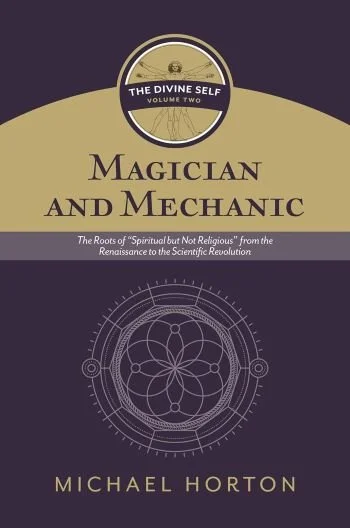
The second of three books in Michael Horton’s must-read series on the “divine-self,“ Magician and Mechanic is a real eye-opener. Horton continues to lay out the fascinating historical background to the contemporary embrace of the “spiritual but not religious” phenomenon. Horton’s project makes the case that this is nothing new, historically speaking, even if new to us.
In this second volume of the series, Horton covers the historical ground from the Renaissance to the Scientific Revolution with some very surprising stops along the way (Erasmus, Thomas More, Christopher Columbus, J. H. Alsted, Thomas Hobbes) and some not so surprising (Savonarola and various Anabaptists). There is much here, so I will briefly summarize big picture themes and leave the details to Michael to explain. His thesis is that the various subjective and hermetic religious expressions of the axial age (the eighth-third century BCE—covered in volume one) never really disappear, but resurface in unanticipated ways throughout the time period Horton covers in volume 2, the Renaissance and the Scientific Revolution following.
Horton identifies two new factors which greatly impact the axial impulse—the divine self seeking some sort of self-realization—in this period. One new factor is the apocalyptic millennialism of Joachim of Fiore (1135-1202). Joachim famously proposed that history unfolded in three stages. The age of the Father was the Old Testament era, the age of the Son ran from the New Testament through to Joachim’s own time, and a third age (the age of the Holy Spirit) was thought to be imminent. The hoped for dawn of the third age added a millennial expectation and fervor since the current religious institutions and governments (which were thought to be corrupt, materialistic, and too political) will give way to the utopian rule of the just and the exercise of perfect love.
Horton recounts in remarkable detail how the critical impact of Joachim’s apocalyptic millennialism appears in multiple thinkers and movements. Joachim is a significant figure—his impact is often overlooked—and is the father of the modern idea of progress. The surprisingly widespread expectation was that the present limits of Christendom and orthodox Christian doctrine would be upended in the new age of the Spirit, which was as yet unrealized, but soon to come. This millennial expectation along with various forms of pantheism and mysticism became the framework for much of the Renaissance era’s surprising interest in astrology, alchemy, kabbala, magic, purgation, and a host of other superstitious practices. These were thought to be the means of discovering the true self which was androgynous—the difference between male and female being just one of the limits to be overcome through the ascent to the fullness of the divine self. The theodicy (the consequence of evil) was often interpreted as God engaging with the material world and its physical limits—something with which the truly “spiritual” must likewise seek to overcome.
A second factor was the redefinition of the Christian doctrine of God. The three persons of the Trinity were commonly re-defined by the self-deifiers as states of existence or developmental stages within God, who is also in the process of “becoming.” The language of God “becoming” is a true red flag with these thinkers, revealing their various heresies disguised with biblical language.
As but one example, pantheistic notions (perhaps panentheism) can be found in the writings of the widely influential German mystic Jakob Böhme (1575-1624). Describing the relationship between Böhme and hermetic spiritualism upon which he draws, Horton describes how in Böhme’s mind, “the corporeal world falls up the side of appearances rather than reality. On the one hand, God needs the world for the self-manifestation essential to his own inner transmutation. On the other hand, matter is transmuted into spirit, creation into creator. Thus the world is God’s appearing” (206). The Creator-creature distinction of orthodox Christianity is obliterated. Böhme, who lived and worked in Lutheran circles was repeatedly forced to dodge accusations of heresy for obvious reasons.
One surprising figure appearing in Horton’s narrative is Christopher Columbus. Another is Amerigo Vespuci, for whom our corner of the New World is named. Since the age of the Spirit had not yet dawned in fullness, many thinkers of the period (such as Thomas More, the author of Utopia) thought that perhaps the age of the Spirit demanded a New World, whose inhabitants (the native Americans) were thought to be the lost tribes of Israel, and whose apparent “innocence” may reflect the ideals of the coming age of the Spirit. Horton notes that several prominent historians—who focus upon this period—claim that Columbus actually presented to the Spanish monarchy a plan to bring the gold of the New World back to Spain to fund the recapture the site of the church of the Holy Sepulcher in Jerusalem and rebuild the city in preparation for the Second Coming (166). One writer, cited by Horton, speaks of Columbus’s apocalyptic interest as “a frenzied preoccupation with a bizarre millennarianism” (168). Not much has changed when it comes to prophetic punditry.
All in all Magician and Mechanic is a fascinating narrative, challenging the secularization thesis, namely, that the scientific rationalism of the Enlightenment and Renaissance was the key factor in overturning Christendom as a political bulwark and even Christianity itself when thought of as a divinely revealed religion. As it turns out, a number of key factors in this demise might be much closer to home.
Must reading! I can’t wait for volume 3, which covers the modern age.
Recommended Links:
Highly recommended: Carl Trueman on the Remnant with Jonah Goldberg
Clark clobbers Webbon. Well done and much needed
Harrison Perkins on covenant theology resources. Very helpful!
Keith Mathison’s top ten biographies of Martin Luther
Here’s a catalogue of Ben Sasse’s senate speeches, interviews, and media appearances all in one place!
Other Stuff You May Find Amusing:
This is easily the headline of the year
This is worth lining up for! One of life’s joys
As if I needed another reason to hate squirrels
Swell, another harbinger of doom. Makes me a bit nervous about why crows love my yard
An Episcopal priest stealing baseball cards? Yup Topps or DonRuss?
OK, this is crazy, frightening, horrifying, yet sort of remarkable. How does this happen?
Daily Mail strikes again — your authoritative source for end times nuttery
Even Roman Catholics are getting in on Antichrist speculation. I wonder what this fellow thinks of WCF 25.6?
No wonder our Roomba is acting up
Is that stuffed owl real? Yup
Graffiti has been around a long time. Ancient tourists vandalize Egyptian tombs
Another surprising use (with a bad outcome) for google translate
Previous Musings: February Musings (2/25/2026)
Video: Okay, this is just plain weird. Weird, but catchy. Those costumes . . .