Musings — Late Summer Edition (8/24/2026)

The muse always comes upon me here . . .
Riddleblog and Blessed Hope Updates:
Note the new musings photo—nowhere else does the muse come upon me as when I am here—Lake Mary in Mammoth
Don’t forget the Blessed Hope Podcast series on Romans is well underway. Thanks for all the great feedback! Such a wonderful and powerful book
I am also going through the Epistles of John in the blog
Thinking Out Loud:
Goodbye Meghan and Harry—don’t let the door hit you on the way out
The City Council of McKinney, Texas (where my son and his family now live), heard five hours of pleas from 120 citizens not to approve a 32,000 sq.ft. Mosque. The council voted 7-0 to approve the site plan. Of course, their minds were already made up and like city councils everywhere, they went through the ritual of hearing citizen complaints, feigning interest while trying not to yawn, but knowing all along what they were going to do before the meeting even got under way. The solution when city councils do this—recall the lot of them
The WNBA just keeps hitting new lows. Caitlin Clark is the best female basketball player I have seen (perhaps Cheryl Miller excepted). Sophie Cunningham is the paradigm “all-American” girl. Because of the two of them, the WNBA has drawn a bunch of new fans, sold a ton of merch, has new media contracts, and is on the verge of sound financial footing for the first time in the league’s history. But the league’s LGBTQ crowd, along with the league’s refs and coaches, treat Clark and Cunningham like they are in the UFC. These two women—the victims of pure jealousy, racism, and spite—deserve much, much better
Why does President Trump feel compelled to issue an executive order to scrap electromagnetic catapults on aircraft carriers in favor of the old steam catapults? He knows nothing whatsoever about the technology and to convert an under construction carrier from electromagnetic catapults back to steam, will cost billions and delay construction by years. Good grief
I used to hear a garage band or two occasionally playing Saturday afternoons in the neighborhood. Not so much any more. My guess is they’ve moved from the garage to playing as “worship bands” in local churches. This way they get to practice once a week before an appreciative audience
Alexis de Tocqueville once mused in his Recollections, “a dwarf on the summit of a great wave is able to scale a high cliff which a giant placed on dry ground at the base would not be able to climb.” The quote was a reference to Napoleon III (Louis-Napoléon), but it certainly applies to a number of contemporary politicians, podcasters, and social media mavens
The famous Roman orator Seneca described how in the Commonwealth of Massachusetts, it was common to drown or discard unwanted babies (infanticide). Oh wait, he was speaking of the Romans, not a progressive American governor (Maura Healy) who signed a law last week allowing abortion up to the moment of birth
I got a kick out of the Abounding Grace Radio’s AI picture of me—especially on an episode devoted to the Antichrist. Besides, I would never wear that tie with that shirt
I forgot to complain about it in the last musings, but endnotes are a tool of the devil and part of his plot to deceive the world by keeping people in darkness
Recently Read:
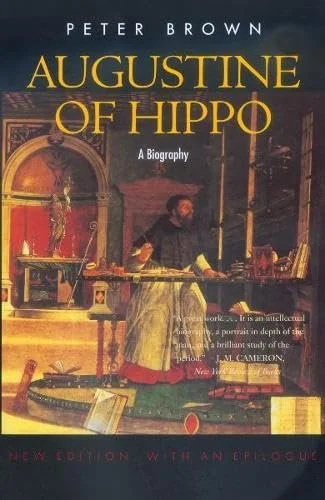
I recently re-read Peter Brown’s outstanding biography of Augustine. I first read it in seminary—it was assigned by Bob Godfrey for his Ancient Church course. I hurried through it—like seminary students often do when they have a heavy reading load that semester. But I determined that at some point, I needed to go back and carefully read it again. That time finally came—some forty years later—and it was well worth digging it out and tackling it anew. This is truly a great work of biography with great footnotes—see my rant above!
As an aside, the printed sales price on the back of my copy is $5.95, but I bought it at the famed Evangelical Bible Bookstore in San Diego, owned and operated by John and Sandra Cully, where it was marked down to $4.00! Quite a bargain, even then. It is worth noting that John Cully sold solid Reformed literature to a legion of Reformed folk. The store closed in January of 2011. That was the end of an era—a family owned and operated Christian bookstore which sold Reformed books and Bibles.
The strength of Brown’s bio of Augustine (354 CE-430 CE) is his skill in setting the cultural and historical context for Augustine’s life and work. When I read this book previously, about all I knew was that Augustine was a North African and an important figure in church history. Having matured in my thinking and knowledge of the Roman empire in the decades since, Brown offers much information with which I was now far more familiar and much better able to process. No real surprises as to content—just the realization that I should have re-read this biography much sooner in my career.
I won’t recount the details of Augustine’s life, since Brown does this quite well. He does so in sufficient detail to be informative and still keep the reader’s interest. As the saying goes, he knows when to quit drilling. Brown is a highly regarded historian and writer—a factual story teller, if you will. He begins by explaining the cultural context and church life in Thagaste—Augustine’s hometown in Numidia (now Algeria). Augustine’s family were probably Berbers. The influence of Augustine’s mother, Monica, is well known, but his father, Patricus, was a pagan and converted to Christianity on his death bed. Augustine had a brother (Navigius) and sister as well. He kept an unnamed concubine for nearly 20 years and she had a son by him (Adeodatus). I recall thinking at the time when I first read Brown’s book, that the great saint was a sort of philanderer—given Augustine’s subsequent reflections upon celibacy, sex, and the nature of lust. But Brown explained that keeping a concubine was a common practice, nothing scandalous, and was treated as a marriage—like a common law wife today.
Brown recounts Augustine’s journey from the backwater of Thagaste (a semi-rural land of olive groves), to the big city, Carthage. Then, soon after Augustine moved to an even bigger city across the Mediterranean (Milan), and eventually to the biggest city of all, Rome. Augustine’s geographical journey mirrors his intellectual pilgrimage. First, was Augustine’s youth—a rambunctious lad who dared to steal the neighbor’s pears, to growing up in the North African backwater amidst nominal Christianity. Then came his Manichean period, during which Augustine became a surprise convert and leading defender and spokesman of the movement. When hitting the road to take his rhetorical skills to Milan, Augustine encountered the famous Ambrose, realized the bankruptcy of Manichean claims, and converted to Christianity—the famous tolle lege story recounted in his Confessions. Augustine became a popular and respected preacher and a prolific author, addressing all of the major controversies of his day—from the Trinity, to the errors of the Manichees, to matters of sin and grace, to ecclesiology, the sacraments, and the church’s relationship to civil society (his renowned City of God). Upon leaving Rome and embracing a celibate life, Augustine (who saw himself as an “African” not a Roman) returned to North Africa as a bishop of Hippo, an ancient Phoenician seaport and then an important Roman colony, just north of Carthage.
Brown’s treatment of the Donatist controversy in North Africa explains how and why the controversy arose—the issue being the Donatist insistence upon the absolute fidelity of church officers and members, coupled with a rejection of “Catholic” Christianity—thought to be corrupt, too closely aligned with pagan Rome,and too prone to compromise on the naming of bishops. If the clergy were not above sin, then their sacraments and prayers were seen to be invalid. The issue was a particularly North African one which Brown carefully details. Donatism quickly declined once the Vandals invaded Numidia, and all Christians subsequently came under persecution.
Augustine’s famous debate with the English Monk Pelagius came toward the end of the former’s life and career when his energy and strength were beginning to wane. Augustine’s treatises written in direct response to various Pelagian errors still stand and are the basis for “Augustinian Christianity,” which occupies a significant status in the churches of the Reformation’s intellectual family tree. But Brown’s discussion of Augustine’s dust up with the Pelagian Julian of Eclanum exposes Brown’s sympathies toward Julian (and perhaps a bit of sympathy toward Pelagius as well). Here, Brown treats Augustine’s response to Julian as that of a cranky old man who had seen enough of Pelagius and his followers, and failed to give Julian the sort of full reply his variety of Pelagianism deserved.
As Augustine fell ill with a persistent fever, Hippo was surrounded by invading Vandals—a Germanic Arian tribe who crossed over from Spain and occupied much of North Africa before laying siege to Hippo. Knowing death was near, Augustine insisted upon being alone, and from his sick bed spent his final days praying and reading large manuscripts of the Psalms hung up on the walls in his room. He died on August 28, 430 at the age of 75—and is no doubt ranked among the most important figures in the history of Christianity.
I put off-re-reading this gem far too long. This one is highly recommended. Tolle lege!
Recommended Resources:
How to read and understand the Book of Revelation
Who was Napoleon III and Why Does He Matter for Contemporary American Politics?
The irony here is that there is no group which spews more hate than the SPLC. And then there’s this: SLPC official arrested for fraud
So what about Luther and the Jews? Carl Trueman reminds us of lessons to be learned from Luther
Wow, some beams found from Solomon’s temple
Reformed Dogmatika has published an excellent series of charts and factoids presenting and defending Amillennialism. Highly recommended!
Fun Stuff:
Islamic cleric decries Western use of toilet paper. Excuse me if I don’t shake his hand
Who on earth would let Gavin Newsom anywhere near a church pulpit?
I’d never wear a football helmet again
Probably not the best place to take a zoom call
So, he’s a time-traveler from 4413? Does he have six fingers and cool futuristic clothing? Of course not. I’ll bet he left his foil hat in the future too
Great way to get rid of flock cameras—just announce they are full of copper wiring and let things take their course
When fido gets his buzz on and demands Jack in the Box tacos
Reminds me of Kramer’s custom license plate
More irony: Mexico warns its citizens about “Uncle Sam’s Revenge”
As a kid, it was a dare to eat chocolate covered bugs—now it is a thing in a two starred Michelin restaurant
Previous Musings: Summer Musings 7/17/2026
Video:
These things can be cheesy, but this one actually works . . .