From “Strangely Warmed” to “Utterly Ashamed” -- Wesley Gets Around to Reading Luther's Commentary on Galatians
John Wesley’s published journals run to four volumes with an opening entry dated October 14, 1735, with his final entry recorded on Sunday, October 24, 1790.
Wesley’s conversion account in 1738 is widely known. Here’s how I describe it in Season Five, Episode One, of my Blessed Hope Podcast deep dive into Romans:
Like Luther, John Wesley was yet another deeply troubled man. For ten years Wesley struggled to live out the demands of the Ten Commandments but finally confessed that he had not obtained freedom from sin, nor the witness of the Spirit, because he sought to gain all of these things through his own futile efforts, rather than through faith in Christ.
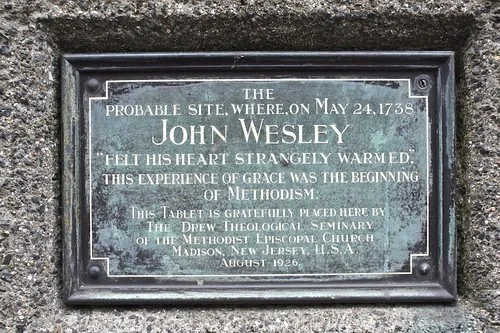
Exhausted and out of answers, he attended a meeting of the Moravian Brethren at Aldersgate street in London. It was there that Wesley heard the Preface from Luther's Commentary on Romans being read aloud. Wesley recalled, “I felt my heart strangely warmed. I felt that I did trust in Christ, Christ alone for salvation.” [1]
I lamented that, “it is too bad that Wesley’s mind was not enlightened when his heart was warmed because he would later go on to reject much of the contents of Luther’s commentary as Wesley’s theology eventually sank back into the semi-Pelagianism of the Middle Ages.”
The degree to which Wesley would later reject Luther becomes apparent in Wesley’s journal entry for Monday June 15, 1741:
I set out for London, and read over in the way that celebrated book, Martin Luther's comment on the Epistle to the Galatians. I was utterly ashamed. How have I esteemed this book, only because I heard it so commended by others; or at best, because I had read some excellent sentences occasionally quoted from it. But what shall I say now, I judge for myself. Now I see with my own eyes? Why, not only that the author makes nothing out, clears up not one considerable difficulty, that he is quite shallow in his remarks on many passages, and muddy and confused almost on all; but that he is deeply tinctured with Mysticism throughout, and hence often dangerously wrong. Two instances, only one or two points--How does he (almost in the words of Tauler), decry reason, right or wrong, as an irreconcilable enemy to the Gospel of Christ? Whereas, what is reason (the faculty so called), but the power of apprehending, judging, and discoursing? Which power is no more to be condemned in the gross than seeing, hearing, or feeling. Again, how blasphemously does he speak of good works and of the Law of God, constantly coupling the Law with sin, death, hell, or the devil; and teaching that Christ delivers us from them all alike. Whereas it can no more be proved by Scripture that Christ delivers us from the Law of God than that he delivers us from holiness or heaven. Here I apprehend, is the real spring of the grand error of the Moravians. They follow Luther, for better, for worse. Hence their "no works," "no law," "no commandments." But who art thou that "speakest evil of the law, and judgest the law?"
Just four years after being “strangely warmed,” Wesley now confesses to being “utterly ashamed” for previously speaking and thinking highly of Luther. It is unfortunate that as early as 1741, Wesley so badly misunderstood (best case) or rejected Luther’s theology (worst case) regarding several critical doctrines. In fact, by the time the Methodist Minutes were published (at some point after 1744), Wesley’s theology was now thoroughly couched in Semi-Pelagian terms, with hints of a full-blown Pelagianism lying just beneath the surface of the discussion recorded in the minutes. On this point, see my prior post, Wesley’s take on election and human obedience.
When Wesley charges Luther with mysticism, he is is making reference to Luther’s negative and at times hyperbolic comments about reason found throughout Luther’s Galatian commentary. Wesley assumed that Luther had jettisoned reason for some form of mysticism which Luther had picked up from the German mystic Tauler. What Wesley fails to understand is that while Luther loudly rejected the magisterial use of reason—reason could discover truth about God apart from revelation, with Luther calling such use of reason, the “devil’s whore”—Luther was no mystic. Elsewhere Luther affirmed the orthodox opinion that reason functions in a ministerial sense, enabling us to understand the Scriptures and distinguish truth from error. Wesley, on the other hand, seems not to know or understand the distinction.
It is also clear that Wesley does not grasp Luther’s various uses of the law as expressed by Luther in his Galatians commentary. Likely due to Luther’s combative style, Wesley completely misses Luther’s main point when the Reformer echoes Paul’s words in Galatians 2:16. Luther was adamant that good works cannot justify, but faith in Christ alone does. Yes, Luther uses some rather choice language directed at Rome in this regard to which Wesley obviously took offense, or flat out misunderstood Luther’s point.
Luther’s views on the three uses of the law are crystal clear, as set forth in his Small Catechism. Luther writes:
First, the Law helps to control violent outbursts of sin and keeps order in the world (a curb).
Second, the Law accuses us and shows us our sin (a mirror).
Third, the Law teaches us Christians what we should and should not do to live a God-pleasing life (a guide). The power to live according to the Law comes from the Gospel.”
That Wesley finds Luther’s distinction between the law and the gospel so unintelligible and problematic exposes deeper issues. No one doubts Wesley’s zeal for proclaiming the gospel to which much of his preaching attests. But Wesley’s evangelical impulses are badly undermined by a theology which defaults to a self-declared Arminianism, and which in actuality is but a hair’s breadth from the errors of Pelagius. Such a theology will indeed feel shame when encountering Luther and sadly, leave people in the same condition Wesley was in before being strangely warmed at Aldersgate in 1738.
_____________________________________
[1] The Works of John Wesley, Third Edition, Complete and Unabridged, Volume 1 (Grand Rapids: Baker Book House, Reprint Edition, 1979), 315-316.