“Ask in Faith”- The Second in a Series on the Book of James (James 1:1-18)
The Background and Context
I wish I could promise that God will not call you to suffer. I wish that I could tell you that living the Christian life is a very easy thing. But I can’t do that. The reason is simple. Neither of these things are true. As you well know firsthand, God does indeed call us to suffer–some of us much more than others. All of us who place our trust in Jesus know full well that the Christian life often includes difficult trials designed to test our faith. Suffering, trials, temptations, and the testing of our faith, are all realities of the Christian life. And all of these difficult issues are raised in the opening chapter of the Book of James, a letter written to persecuted Christians living during the most trying of times.
Lets jump right in and make our way through the first eighteen verses of the opening chapter of James. Last time, we spent a great deal of time on introductory matters–which are very important when it comes to interpreting this book correctly. In the introductory essay, I attempted to make my case that we can best interpret this epistle by looking carefully at James’s role in apostolic history, which, I think, serves to eliminate many of the difficulties which are often raised by those who seek to pit James against Paul, and who see this book as nothing more than Jewish legalism. So, I strongly encourage you to read the previous exposition, because much of what we’ll be doing in this series grows directly out of the historical context which I labored to establish in the initial installment.
To briefly recap, if the Book of James was written before the Jerusalem Council in CE 48 as recounted in Acts 15, this means that James is writing before the controversy between Jewish and Gentile Christians over justification broke out in the Galatian churches. An early date for the Book of James is an important key to resolving the supposed controversy between James and Paul over the doctrine of justification. James’s epistle was very likely written before any of the gospels were composed, and during that time in the mid-40's when Christianity was rapidly spreading throughout Jerusalem, Palestine, and Syria. This time frame helps us to identify James’s original audience (persecuted Jewish Christians), as well as the purpose for which this epistle was written–to exhort these persecuted Christians to put their faith in Christ into action. Paul does not contradict James. Paul is dealing with a controversy between Jewish and Gentile Christians over the doctrine of justification, while James is writing to exhort struggling Jewish Christians not to be satisfied with being mere hearers of the word only. James is exhorting his reader to be a doer of the word, which is important counsel to persecuted Christians.
There are a number of important issues raised by James early-on in his epistle. In verses 2-4, James speaks of the trials his readers were then enduring, and he encourages them to respond to these trials in faith. To enable believers to see their trials as a test of their faith (and not as some sort of punishment), James exhorts his readers in verses 5-8 to seek wisdom from God, something God will graciously give them, if only they ask him in faith. In verses 9-11, James offers the poor a word of encouragement, while at the same time warning the rich about misplaced confidence in their personal wealth. In verse 12, James pronounces a blessing upon Christians who endure their various trials, while in verses 13-15, James warns Christians not to blame God for the temptations which they face. And then, in verses 16-18, James informs us that all good gifts (including regeneration) come from the hand of a gracious God.[1] So, there is much here in the opening verses of James, so lets jump in and get started.
James’s Introductory Remarks
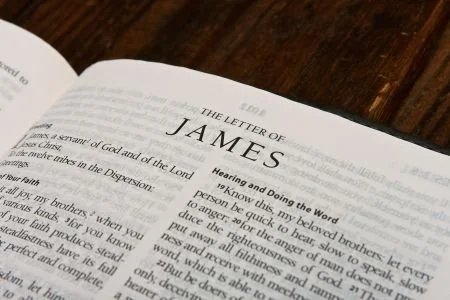
In verse 1, we meet the author and we learn about the intended audience of this epistle. The introductory remarks are short and to the point. “James, a servant of God and of the Lord Jesus Christ, To the twelve tribes in the Dispersion: Greetings.” As we saw in our introduction to the epistle, this particular James is the brother of Jesus. Interestingly enough, James speaks of himself as a servant of God (the father) and of Jesus Christ. Although James is Jesus’s half-brother, he does not pull rank– “I’m James, Jesus’s brother, so listen to me.” Rather, he speaks of himself as Jesus’s servant. As one of the church fathers reminds us, there are two kinds of servitude–forced servitude and voluntary servitude. Someone who is forced into servitude will hate and fear his master. But someone who volunteers to serve a master, in a sense, becomes like a son to the one whom he serves.[2] This is the case here.
James grew up in the same household with Jesus. As we read in Mark’s gospel (6:3), along with Mary, James tried to stop Jesus from preaching when his messianic mission began causing great controversy with the Pharisees. In fact, James did not believe that Jesus was the Son of God, until Jesus appeared to James after his resurrection (1 Corinthians 15:7). Remarkably, as James opens his epistle, he confesses that Jesus is Lord (to whom he submits), that Jesus is the Christ (Israel’s Messiah), and James makes it very clear that he is Jesus’s willing servant. As one commentator notes, “James’ view of Jesus has undergone quite a transformation since the days when they grew up in the same household together.”
The Diaspora – A Time of Tension and Persecution
As a servant of Jesus, James is writing to members of the “twelve tribes in the dispersion.” This is clearly a reference to Jewish Christians who have been dispersed throughout Palestine due to the kind of persecution depicted in Acts 11:19, where we read, “Now those who were scattered because of the persecution that arose over Stephen traveled as far as Phoenicia and Cyprus and Antioch, speaking the word to no one except Jews.” Stephen, a Greek-speaking Jew, became the first Christian martyr as recounted in Acts 7. Stephen’s death became the flash-point for great hostility toward those Jews who, like James, had come to believe that Jesus was both Lord and Christ. The large number of Jews becoming Christians during this time created a very tense situation in which true Israel–those Jews who see in Jesus’s death and resurrection the fulfillment of God’s promise to Abraham–became virtual outcasts in their own land. Many were forced to leave large cities and seek safety in out-lying areas. These scattered refugees were James’s intended audience.
It is important to keep these circumstances in mind as we work through this letter. Imagine the difficulties which arose when someone in a Jewish household in Palestine unexpectedly became a believer in Jesus. Chances are the person’s family completely disowned them. It would have been difficult to find work, and such people would have been cut-off from both the Jerusalem temple and the local synagogue. There was no unemployment insurance or welfare from the state (Rome). The synagogue took care of the poor and needy, but a convert to Christianity became a virtual outcast and was cut off from relief. A Jewish believer in Jesus would have been shunned by everyone. These new Christians began to congregate in churches (which were now forming in homes away from the synagogue), and this is the context in which James is writing.
When James speaks of the twelve tribes in the diaspora (dispersion), he’s also alluding to a major theme in the writings of the prophets (Isaiah 11:11-12; Jeremiah 31:8-14; Ezekiel 37:21-22; Zechariah 10:6-12) in which God would reconstitute the twelve tribes in the messianic age, after the nation had been taken captive and hauled off to Babylon. James now sees these prophecies as fulfilled when true Israel is reconstituted as the church in the last days. Therefore, James is writing to his persecuted brethren, the true Israel, now scattered among the nations, where they will be a witness to the Gentiles of the grace and mercy of Israel’s God. In this case, God uses the Jewish persecution and suffering of Jewish converts to Christianity, as the means of spreading the gospel beyond the narrow confines of Jerusalem and Palestine. The scattered faithful take the gospel with them so that Christianity spreads.
Difficult Trials Will Come to Strengthen Faith
In light of this situation, James immediately raises the matter of how these difficult trials do, in fact, have a purpose. That doesn’t lessen the difficulty of the trial, but it does put the Christian’s suffering into proper perspective. God uses difficult times to bring about the completeness (maturity) of faith. Thus James exhorts his reader in verses 2-4, “Count it all joy, my brothers, when you meet trials of various kinds, for you know that the testing of your faith produces steadfastness. And let steadfastness have its full effect, that you may be perfect and complete, lacking in nothing.”
I know how trite it can sound when someone quotes James and tells the miserable sufferer, “count it all joy.” But James not asking us to ignore our circumstances, to just suck it up (as would a Stoic), and be joyful, regardless. No, James is telling us that God allows trials to come for a reason–trials make us steadfast, they strengthen our faith. While James does exhort us to be joyful in the midst of suffering, he also tells us that when we undergo trials, there is a purpose, our faith is being tested. A faith which has been tested, is a faith which becomes steadfast, a faith which endures in difficult times, a faith which becomes much stronger than it was before the trial.
Joy is simply the knowledge that it is well with our souls, despite our present circumstances. It may not be well with our bodies. It may not be well with our job, or with our particular circumstances. But because Jesus died for our sins, and because he was raised for our justification, it is well with our souls, despite everything else we are going through, and despite how we may feel at any given moment. And the only reason we can have joy in the midst of difficult circumstances is because we know that God’s anger with us was dealt with at the cross, once and for all.
Our Trials Are Not Retributive Punishment
Whatever trials we may be experiencing do not come about because God is retributively punishing us. Rather, trials will come because God is allowing our faith to be tested, so that our faith becomes stronger, and so that we become steadfast and more resolute. Therefore, says James, we are to accept these trials as a means of testing, and allow God to make us complete, by bringing his work in us to its fruition. This is how our faith becomes perfect and complete, not lacking in anything. Trials are the refining fire, the means by which our faith is made strong, steadfast, built-up, robust. Suffering of any sort is horrible. No one wants to suffer. No one likes to suffer. But suffering does have a purpose in God’s economy–even if that purpose is known only to God. James can exhort his reader to count our trials as an occasion for joy, because Christians know that God is accomplishing his mysterious purposes in us, and that purpose involves bringing us to maturity.
To receive the help we need to endure our trials so that our faith can be strengthened, James exhorts us to ask for wisdom–something God will freely give us, if only we ask him for it. It is not as though God allows trials to come into our lives and then leaves us to our own devices. In verses 5-8, James writes,
If any of you lacks wisdom, let him ask God, who gives generously to all without reproach, and it will be given him. But let him ask in faith, with no doubting, for the one who doubts is like a wave of the sea that is driven and tossed by the wind. For that person must not suppose that he will receive anything from the Lord; he is a double-minded man, unstable in all his ways.
In this assertion, James echoes the Book of Proverbs, specifically the declaration in Proverbs 2:6-10 in which it is written,
For the Lord gives wisdom; from his mouth come knowledge and understanding; he stores up sound wisdom for the upright; he is a shield to those who walk in integrity, guarding the paths of justice and watching over the way of his saints. Then you will understand righteousness and justice and equity, every good path; for wisdom will come into your heart, and knowledge will be pleasant to your soul.
Wisdom is the God-given means by which a person can discern the will of God, so that they know what it is that they are supposed to believe about God and his purposes in the midst of difficult times.[4]
Because he knows many in his audience desperately need God’s perspective so as to sustain them in their suffering, James exhorts his readers to ask God for wisdom. At this point, James is restating the words of Jesus in Matthew 7:7, when Jesus declared “ask, and it will be given to you; seek, and you will find; knock, and it will be opened to you.” This is the first of many instances in this epistle in which James directly alludes to the teaching of Jesus. James’s point here is that God freely gives his wisdom to his people whenever they ask him for it. That said, James exhorts us to ask God for it in faith, which simply means that we ask for wisdom with the expectation that we will be given that for which we ask. This too echoes the words of Jesus. In Matthew 21:21-22, Jesus says, “`Truly, I say to you, if you have faith and do not doubt, you will not only do what has been done to the fig tree, but even if you say to this mountain, ‘Be taken up and thrown into the sea,’ it will happen. And whatever you ask in prayer, you will receive, if you have faith.’” James says much the same thing here.
But asking a sufferer in the midst of great suffering to “ask in faith” can be cruel, especially if the sufferer is at the end of their rope, and especially if we throw the “asking in faith” line at them in a self-righteous, flippant manner. The solution to this problem, James says, is to ask in faith without doubting. And the way we are able to ask for wisdom in faith without doubting, is not to look within at the strength of our faith, or to focus upon the difficulty of our circumstances. The key to asking in faith without doubting, is to look carefully at the track-record of the one whom we are asking for wisdom. When we consider that God foreordains whatsoever comes to pass, that he is all wisdom, that Jesus is Wisdom incarnate (wisdom in human form), and that God has kept each and every one of his promises, only then can we ask him for the wisdom he has promised in faith, without doubting. The key is not us, but the track-record of the one whom we are asking. It is much easier to keep from being double-minded, if we keep before us the wonderful examples of the obedience of Jesus, and the faithfulness of God in keeping his promises.
Poverty and Riches
In light of the difficulties then facing James’s struggling audience, James now takes up the subject of poverty and riches. This section of James is one of the most difficult in this epistle to interpret because it is hard to tell if the rich are unbelieving Jews persecuting suffering Jewish Christians, or if the rich are wealthy Jewish Christians who have a misplaced confidence in their wealth.[5] In verses 9-11, James speaks directly to the question of what constitutes the Christian’s proper perspective on this matter.
Let the lowly brother boast in his exaltation, and the rich in his humiliation, because like a flower of the grass he will pass away. For the sun rises with its scorching heat and withers the grass; its flower falls, and its beauty perishes. So also will the rich man fade away in the midst of his pursuits.
A fellow Christian may appear “lowly” by human standards–poor, downtrodden, and outcast. Yet, those who are suffering for the cause of Christ, actually possess all the riches and treasures of heaven. The lowly, James says, can exalt (or even boast) in the fact that in God’s economy they occupy a position much, much, greater than any rich, powerful, and famous person may occupy in this life. This is why the lowly poor are to boast in Christ. Jesus is their treasure in whom they can boast.
But the one who is rich (whether they are Christians, or not) likewise needs to see things from God’s perspective. Should James be referring to a Christian who is wealthy, James reminds them that they are united to Christ in his suffering (his lowliness and poverty), and that they should be very careful not to boast in their riches, power, and fame, which can perish in but an instant. Those who are rich must likewise boast in their identification with Christ and his suffering people. In him, they find true humility.
This is the great paradox non-Christians simply cannot understand. Wealth and poverty are not the visible manifestation of God’s ultimate blessing and curse. Wealth and poverty are part of God’s mysterious providential purposes for his people. There will always be wealthy Christians and poor Christians, ideally becoming one people in Christ’s church. But non-Christians see wealth as life’s ultimate goal, and poverty as life’s ultimate curse.
Christians understand that while wealth and poverty are very important circumstances of life, neither wealth nor poverty have anything to do with God’s blessing poured out upon his people in Christ. The poor, persecuted Jewish believer in Jesus has a wealth that those persecuting them can never understand. The wealthy Christian understands that they have a great responsibility to be good stewards of their wealth, and they must choose to identify with Christ in his suffering as well as with the suffering of his people. A wealthy Christian knows that wealth can disappear in one blast of scorching heat. And yet, they too, like the poor persecuted Christian, possess a heavenly wealth that the twists and turns of this life can never take away. To trust in wealth, power, and fame, James says, is to be contaminated by the world. Rather, both rich and poor are to boast in Christ, because in Christ, both are truly blessed beyond anything found in this life.
Suffering and Temptation
Having informed both rich and poor where to place their confidence, James now pronounces a blessing upon the sufferer, and then turns to the subject of what to do in the face of temptation. In verse 12, James speaks a powerful word of encouragement to those facing difficult trials. “Blessed is the man who remains steadfast under trial, for when he has stood the test he will receive the crown of life, which God has promised to those who love him.” While prosperity preachers have twisted this verse completely out of its context, the fact of the matter is that James does indeed promise God’s blessing to those who faithfully endure their trials. The Christian who is undergoing a great trial must look beyond their current circumstances, to what ultimately lies ahead. God never promises to end our struggles, but he does promise to reward those who endure them faithfully. The image of a crown (a laurel-wreath) is one drawn from the athletic field. Like an athlete, the Christian must strive to complete the race and thereby receive the crown. In this case, the crown is the blessing of eternal life, in which those who endure will be blessed with a kind of life beyond anything we can imagine. James does not give us any specifics about the promised life, but James is clear that God rewards those who faithfully endure their trials.
To those who suffer, James says, endure those sufferings with the knowledge that God himself will give you the crown of life. While James does not speak about the nature of the life which is promised, John does in Revelation 21:3-4:
And I heard a loud voice from the throne saying, “Behold, the dwelling place of God is with man. He will dwell with them, and they will be his people, and God himself will be with them as their God. He will wipe away every tear from their eyes, and death shall be no more, neither shall there be mourning, nor crying, nor pain anymore, for the former things have passed away.
Now, it is absolutely vital that we are clear about the fact that while God allows us to go through trials so as to strengthen our faith, God never tempts us to sin. In verses 13-17, James writes,
Let no one say when he is tempted, “I am being tempted by God,” for God cannot be tempted with evil, and he himself tempts no one. But each person is tempted when he is lured and enticed by his own desire. Then desire when it has conceived gives birth to sin, and sin when it is fully grown brings forth death. Do not be deceived, my beloved brothers. Every good gift and every perfect gift is from above, coming down from the Father of lights with whom there is no variation or shadow due to change.
James makes two very critical points in these verses. The first is that God does indeed allow trials to come our way. The second is that sin arises in us (because we have a sinful nature), not because God somehow tempts us to sin.
God Does Not Tempt Us To Sin, Nor Did the Devil Make Us Do It
What this means in practical terms is simply this: you cannot blame God for your sin no matter how difficult your circumstances. The devil did not make you do it. We sin because sin begins with our own sinful desires, these desires pop into our minds, and then we make a conscious decision to act upon those desires. And our sinful actions earn for us the appropriate wage, death. So, while God allows trials to come our way, God does not “tempt” us to sin. This means that God is not in any sense the author of evil, although God has decreed that evil, which arises in his creatures, not in himself, is part of his grand purpose for human history. On the contrary, says James, God is the giver of every good and perfect gift. God has no sinful desires. God never changes. This is why James says that if we blame God (or someone else) for our own sin, we are self-deceived.
Since God is the author of all good things, James is able to move from the doctrinal import of this to the practical consequences of this for the sufferer. As James puts it in verse 18, “Of his own will he brought us forth by the word of truth, that we should be a kind of firstfruits of his creatures.” God sovereignly brought us forth (a reference to regeneration) through the word of truth (likely a reference to the preaching of the gospel), and that those undergoing these trials because of their faith in Christ, will be the first fruits of creation.
In other words, God brought James’s readers to faith in Jesus Christ so that they will become the down-payment on what will eventually happen to all of creation–God will remove the curse and every hint, trace, and stain of sin. In the midst of their trials, James’s reader is to consider the fact that while God allows them to undergo this trial, he is not tempting them to sin. Yes, God is allowing their faith to be tested, but as the author of every good and perfect gift, the suffering saint must realize that God himself has graciously given them eternal life through the gospel, and even more, he will freely give his suffering saints boundless wisdom, if only they ask him in faith.
Our Perspective on Suffering Is What Matters
Therefore, at the end of the day, the solution to the problem of the suffering of the saints is one of perspective. The persecuted Jewish Christians to whom James is writing must understand that suffering comes from human sinfulness, not from God. But in ways we cannot fully grasp, God will indeed use these difficult trials to strengthen our faith, to make us strong and steadfast, and to bring his work in us to its ultimate goal–that we may be perfect and complete, lacking in nothing.
To help us grasp this–which is never an easy thing to so when we are in the midst of trials–James exhorts us to ask God for the wisdom we need to gain the proper perspective. And that wisdom from God tells us that the theological truth which underlies James’s exhortation is the knowledge that he does not tempt us to sin because he is the author of every good and perfect gift. Because God has brought us forth through the preaching of the gospel, and given us faith, everything which happens to us, does so for a reason. This is the proper perspective we need so that we can count all of these things as joy.
Since God has begun this work in us by giving us life, God will see his work through to completion. How do we know that? Because God has promised to do this, and because he is the giver of every good and perfect gift, he will give us all that we need. All that he asks of us is that we ask him for what we need in faith, and that we do not doubt. And we can only ask in faith without doubting if we see our gracious God as the giver of all good and perfect gifts. Beloved, we see that good and perfect gift in the person and work of Jesus Christ, both Lord and Christ, as well as wisdom incarnate.
___________________________________
[1] Moo, The Letter of James, 50.
[2] Gerald Bray, editor, Ancient Christian Commentary on Scripture, New Testament XI, James, 1-2 Peter, 1-3 John, Jude (Downers Grover: InterVarsity Press, 2000), 2.
[3] Moo, The Letter of James, 49.
[4] Moo, The Letter of James, 57.
[5] See the discussion in: Moo, The Letter of James, 63-69; and Peter H. Davids, The Epistle of James, NIGTC (Eerdmans, 1982), 41-47.