A "Holy" Pope Yet to Come? We Are Still Waiting
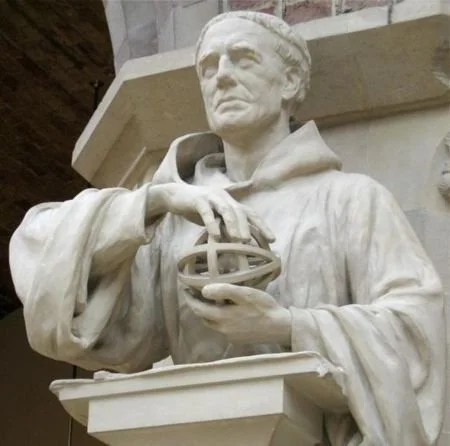
The Statue of Roger Bacon at Oxford’s Museum of Natural History
You Think Antichrist Speculation Is Bad Now . . .
Antichrist speculation was rife at the end of the thirteenth century. A number of those influenced by the noted apocalyptic thinker Joachim of Fiore (b. 1135, d. 1202) expected the Lord to return by 1260. This was a date derived from a misreading of several texts in the Book of Revelation (cf. Revelation 11:2-3; 12:6). When this did not happen as hoped for, those left behind were forced to explain why the Lord had not come back. In previous posts, I considered antichrist speculations of two prominent Franciscan theologians, Gerhoh of Reichersberg, and Adso of Montier-en-Der, who had much to say about an imminent appearance of the Antichrist in the tenth (Adso) and eleventh centuries (Gerhoh). If our own age is dogged by end-times speculation, we have nothing on the medievals when it comes to attempting to identify the Antichrist.
Throughout the thirteenth century, the Roman Church was thoroughly corrupt and made little effort to hide it or do anything about it. A large and influential “reformist movement” (including many Franciscans) lamented the sad state of the church and sought its reform. Some even speculated that a future, evil pope, might even be the Antichrist.
But there were other factors driving the eschatological fervor of the period. One was the influence which Joachim had upon much of the church’s eschatology–although Aquinas and Bonaventure resisted much of this speculation. Famous for his understanding of history unfolding in three stages, Joachim taught that the final stage was to be the age of the “Spirit” which had not yet dawned. The anticipation of a truly “spiritual” age encouraged all sorts of wild speculation about when this age would begin, what things would be like when it did, and what events would occur before it does.
A second factor was that in addition to the corruption running throughout the Roman Church’s hierarchy, the first crusade began in 1096. The collective goal of successive crusades was to recapture the holy sites in Jerusalem. The crusades found some initial success—taking Jerusalem—but the holy city was later retaken by the “Saracens” (Muslims). This raised all sorts of troubling questions about why the Lord had allowed such a calamity to occur after what had been proclaimed as a great victory for the crusaders. Was God going to punish his disobedient church by sending an Antichrist?
Third, the crusades played out against the backdrop of the schism between the Roman and Greek Churches in 1054 (known today as the East-West Schism). The Greeks (now known as the Eastern Orthodox) would not submit to the authority of the pope and were considered heretical by Rome on several key points, including the filioque clause in the creed, the use of leavened bread in the sacrament, and differences in the liturgy. During the crusades, soldiers and armed thugs supporting Rome, made their way East to liberate the “holy land.” The crusaders at one point invaded and conquered but eventually lost Constantinople, the heart of the Greek Church and Byzantine Empire. But all of this progress followed by repeated setbacks, and given the intense hostility and warfare within Christendom, this generated much speculation among the followers of Joachim as to whether the Greek Church might be the seat of the Antichrist, or whether a reunion of the two churches would be a harbinger of the end.
Fourth, geopolitical events were a major source of anxiety. The Tartars, a Turkic people allied with the Mongol Empire, invaded Islamic regions, and even captured Jerusalem from the Muslims for a time. They also pressed deep into Eastern Europe causing fear and terror in Rome in the wake of their advance. If any people were thought to be capable of producing an Antichrist it was the Tartars. Yet another threat to the Roman Church was Frederick II, the Holy Roman Emperor, who organized a fifth crusade, which failed horribly in Egypt, and who was eventually excommunicated and considered by many to be the Antichrist.
Then, as now, identifying the Antichrist was an ongoing enterprise with a large cast of possibilities.
Enter Roger Bacon and the Coming “Angelic Pope”
A noted Franciscan theologian, the Englishman Roger Bacon (1219-1292), attempted to tamp down the Joachite speculations once the date of 1260 had come and gone without the coming of the Antichrist, the Lord’s return, or the dawn of Joachim’s third age—that of the Holy Spirit. Bacon was a highly respected polymath, known as Doctor Mirabilis. He was an accomplished philosopher, scientist, and theologian. In the midst of such prophetic speculation and uncertainty, Bacon sought to change the discussion by raising a new sort of eschatological hope, that of an “Angelic Pope.” This holy pope would appear and successfully deal with the corruption in the church (the lawyers and lawsuits mentioned below), he would unite the Greek Church with the Roman (ending the East-West schism), he will convert the Tartars and the Jews, and then defeat the dreaded Saracens. Bacon hoped this pope would enable Christians to prepare for an Antichrist in addition to his prediction of an eventual end of Islam after 693 years (based upon calculations using the Arabic calendar).
Like Adso and Gerhoh before him, Bacon composed a treatise on the matter in 1267, and sent it to the then current Pope, Clement IV. Here is an excerpt from Bacon’s treatise . . .
O most holy Father and wisest Lord, may your glory deign to consider that you alone are able to bring the cure since there never has been, nor will be, I believe, a pope who knew the law as truly as you do. Even though some men knew the law well, there is no hope that they will become pope. Forty years ago it was prophesied, and there have been many visions to the same effect, that there will be a pope in these times who will purify Canon Law and the Church of God from the sophistries and deceits of the jurists so that justice will reign over all without the rumbling of lawsuits. Because of the goodness, truth, justice of this pope the Greeks will return to the obedience of the Roman Church, the greater part of the Tartars will be converted to the faith, and the Saracens will be destroyed. There will be one flock and one shepherd heard (John 10:16). One who saw these marvels in his own time. Certainly, if God and the pope so wished, they could happen within the space of a single year, or even in less time. This could happen in your reign.[1]
Bacon’s eschatological expectation centers around the perfection and expansion of the Roman Catholic church, a sort of papal millennial “golden age” through the appearance of a “holy,” “wonderous,” “most blessed,” pope who will clean up the church and bring the nations into the fold of the Roman Church. This pope will be assisted in this effort by a “greatest prince,” who would use the sword to assist the holy pontif to “work together for the renewal and expansion of Christendom.”[2] Bacon wasn’t at all shy about advocating a union between pope and prince—uniting spiritual and military power under the pope’s direction to achieve the aformentioned goals.
But notice what, or better, who is missing. Nothing is said about Christ’s return as the center of a Christian’s future hope, only the expectation of a “holy” pope, who has not yet made his appearance some 750 years after Bacon’s prediction.
________________________________________
[1] Translated from J. S. Brewer, Fr. Roger Bacon Opera Quaedum Hactenus Inedita (RS 15 page 86), and taken from Bernard McGinn, Visions of the End: Apocalyptic Traditions in the Middle Ages (New York: Columbia University Press, 1998), 190.
[2] Brett Edward Whalen, Dominion of God: Christendom and Apocalypse in the Middle Ages (Cambridge MA: Harvard University Press, 2009), 192-193.